

Ants are among the most plentiful and formidable creatures on the planet Earth, able to use their vast numbers and collective problem solving skills to defend their nests from even the largest attackers, but nothing in nature is without its enemies, and with their staggering numbers, ants have racked up quite the list of ant-agonists (sorry). Creatures that specialize in living with or living off ants are known as “myrmecophiles,” and while some of them are harmless or even helpful to their ant roommates, others use devious trickery to feed off the colony.
10. Ant-loving Snail
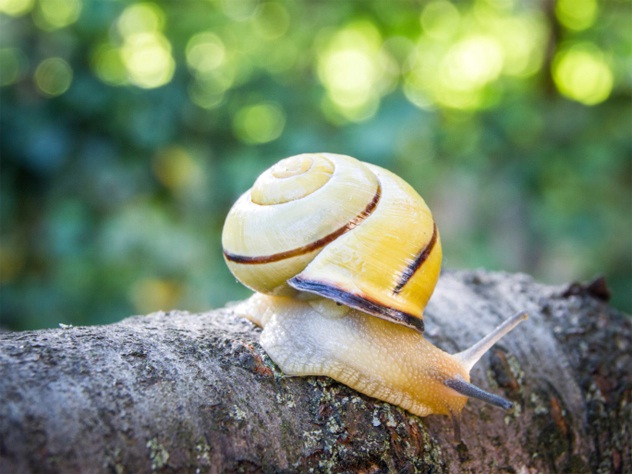
There are many different insects and arachnids who sneak into ant nests, but it’s a much more unusual lifestyle for a mollusk. The snail Allopeas myrmekophilos uses a tasty-smelling slime to deliberately get itself captured by ants, but once inside the nest, it stops smelling like food and goes completely ignored, living off the colony food supply as a freeloader.
9. Eucharitid Wasp

The closest cousins to the ants, wasps are highly diverse creatures with many specialized lifestyles. This particular species is an ant parasitoid; it leaves its tiny larvae on plants where they attach to passing ants and get carried back to the colony. There, they feed on the ant brood until ready to mature.
8. Oogpister Beetle
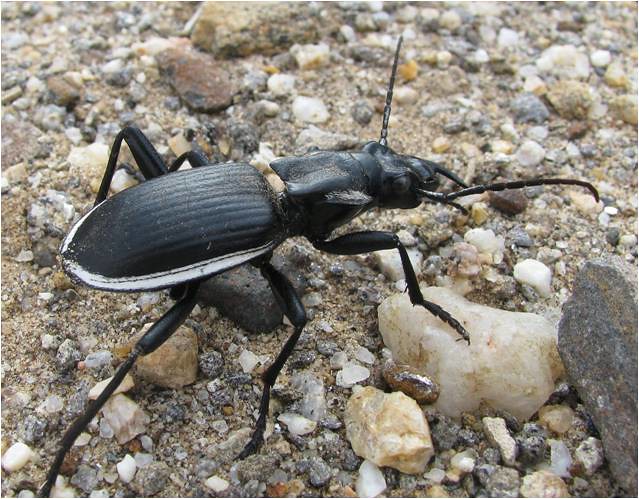
This large, predatory ground beetle preys almost exclusively on ants, but doesn’t bother trying to trick them; it storms in to ant territory, gobbles them up in its jaws, and uses its legs to kick away any ants who try to ward it off. Amazingly, the beetle extracts acids from the ants which it can then spray from its abdomen to defend itself from larger predators.
7. Microdon Maggot
Microdon is a Phorid fly, like the common fruit fly, whose strange maggots were once mistaken for a species of slug. With their flattened shield-like bodies and a protective odor, these maggots pretend to be just another part of the ant nest as they prey upon helpless ant larvae.
6. Liphyra Caterpillar

While it closely resembles the Microdon maggot and enjoys the same diet of baby ants, Liphyra is actually a caterpillar, the larva of a butterfly, which simply stumbled upon very similar adaptations. Rather than disguise itself with odor, however, the body of Liphyra is just completely, perfectly impenetrable to ant jaws. It may be attacked by ants constantly, but will still spend months in their colony, leisurely devouring their young without a scratch.
5. Blue Butterfly Caterpillar

A much sneakier caterpillar, larvae of the Blue Butterfly imitate both the scents and sounds of queen ants to receive royal treatment, and will even trick the ants into preferring them over the real queens. In one experiment, queen ants, workers and caterpillars were placed in a tank together; the queen ants immediately attacked the caterpillars, only for the workers (their own children) to break up the fight and drag the larval butterflies to safety. Though brought a steady stream of food by the workers, they may also dine on ant eggs and larvae.
4. Larva mimic Fly
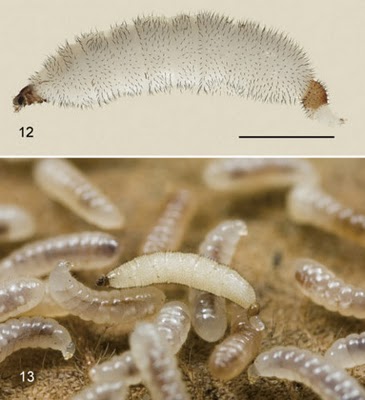
What you’re looking at here may resemble just another maggot, and it’s even a close relative of Microdon, but this is actually an adult, female fly. She has no wings, and her huge abdomen – which is over 90% of her body – looks, smells and feels exactly like the larva of ferocious army ants. This one doesn’t harm any ants, but does enjoy free food and protection from the colony. Males are more normal-looking, winged flies who travel from colony to colony, mating with the freeloading ladies.
3. Paussinae
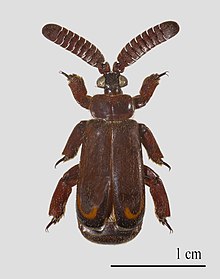
Paussinae beetles are a type of “bombardier” beetle, able to spray a defensive chemical concoction from their abdomens. Many species are Formicaphilic in many different ways; some use their sharp jaws to feed on young ants, others use spoon-like mouthparts for lapping up liquid food regurgitated by ant workers. It isn’t fully known what their giant, sometimes disc-shaped antennae are for, but ants have been seen using these antennae as handles to pick up and carry the beetles.
2. Ant Mugging Flies

When an ant is hungry enough, she may use her feelers to tap out a special signal on another ant’s face, triggering her sister to regurgitate a bit of liquid food. It’s this kind of instinctual sharing that makes ants such survivors in the first place, so you knew something would evolve to take advantage of it. Ant-mugging flies use their strange, clamp-like antennae to grab the feelers of ants, then use their tubular mouths to imitate the tapping that makes the ant spit up. The fly makes off with the sticky glob of food, and the ant is left momentarily dazed.
1. OTHER ANTS
Of course, the greatest enemies of ants are themselves, and one way in which ants get the better of one another is a lot like the relationship between mice and man; sometimes an extremely tiny species will connect their own tunnels to those of much larger ants, allowing them to sneak around and steal food from under the giant’s noses. Other ants actually “kidnap” and “enslave” ants from other colonies, some so adapted to this lifestyle that they can’t even eat without some other species to chew for them. Most sinister of all are parasites like Solenopsis daguerrei; a queen of this species never bothers making a colony of her own, but attaches herself to the body of another ant queen, sterilizes her and begins to steal her food. The hapless colony will care for the parasite’s eggs until their queen wastes away, and the parasitic ants, once mature, will leave the doomed nest to invade even more colonies.
On a final note, if you’re wondering why I didn’t write about Anteaters in a list of the greatest threats ants have ever faced…their names are a bit of a misnomer. Anteaters prefer to eat termites, which belong to the cockroach family!
10 Comments
When I walk through the brush on my pathway to go filshing I get bitten by fire ants. Is thee a way other than fire ant poison to keep them out of a 36 inch path.
Serious question… why are Cockroaches and ants are not natural enemies? If scientists somehow figure out how to make ants attack cockroaches, we may solve cockroaches problem!
Ants and Cockroaches are natural enemies to humans. Unless you like living with them. I refuse to visit California because of the amount of Cockroaches they have down there. One flew from a bush, bounced off a car, hit the house and flew up my girlfriends back and when I whooshed it off….it went to my arm and on my face. The thing was so big, plus the ones I saw crawl out of a bathtub drain, then all over the inside of houses eating any foods open or in the frig. I have seen them restaurants. I worked at casinos cleaning kitchens and saw them coming from the walls and other. The part that really etched its way in my mind is when I was in Santa Ana and the City pulled a bush from the ground and millions of Cockroaches spread so fast. They were prepared, workers dumped two 5 gallon buckets of diesel on them and lit it before they could spread even further. The bigger they are the warmer the weather is. Even where fleas cant live in higher altitudes, Cockroaches will adapt to any climate…..with the exception of freezing areas year around.
what about us “human” ?
This is a list of animals who adapted especially to prey upon or parasitize ants. Humans wouldn’t count at all, we kill all sorts of things, not just ants…and even then, we wouldn’t be anywhere near the top ten. Ants persevere no matter what we do to them. We wouldn’t even make a top 100.
no ant eater…what the hell
I explain that at the very end…anteaters are more adapted to eat termites, not ants.
Great list! I had no idea half these things existed and I had no idea wasps were related to ants. The Ant Mugging Fly was the funniest and is appropriately named. 😀
I loved this list, this may be one of my favorites so far. Things like this always interest me, so thank you for writing it.
you forgot giant humans and magnifying glasses those are the worst enemies of ants