

The world has never been more technologically advanced than it is now, but that doesn’t mean that some things haven’t been lost along the way. Many of the technologies, inventions, and manufacturing processes of antiquity have simply disappeared with the passage of time, while others are still not fully understood by modern day scientists. Some have since been rediscovered (indoor plumbing, road building), but many of the more mysterious lost technologies have gone on to become the stuff of legend. Here are ten famous examples:
10. Stradivari Violins

One lost technology of the 1700s is the process through which the famed Stradivari violins and other stringed instruments were built. The violins, along with assorted violas, cellos, and guitars, were constructed by the Stradivari family in Italy from roughly 1650-1750. The violins were prized in their day, but they’ve since become world famous for having an unparalleled—and impossible to reproduce—sound quality. Today there are only around 600 of the instruments left, and most are worth several hundred thousand dollars. In fact, the name Stradivari has become so synonymous with quality that it has come to serve as a descriptive term for anything considered to be the best in its field.
How was it Lost?
The technique for building Stradivari instruments was a family secret known only by patriarch Antonio Stradivari and his sons, Omobono and Francesco. Once they died, the process died with them, but this hasn’t stopped some from trying to reproduce it. Researchers have studied everything from fungi in the wood that was used to the unique shaping of the bodies in order to describe the famous resonance achieved by the Stradivarius collection. The leading hypothesis seems to be that the density of the particular wood used accounts for the sound. Still, some dispute the claim that the instruments are special at all. In fact, at least one study concluded that most people don’t even notice a difference in sound quality between a Stradivari violin and a modern counterpart.
9. Nepenthe

The sheer sophistication of the technology wielded by the ancient Greeks and Romans is often quite astonishing, especially when it came to medicine. Among other things, the Greeks were known to treat the bereaved with Nepenthe, a primitive anti-depressant that was known for its ability to “chase away sorrow.” The drug is frequently mentioned in Greek literature like Homer’s Odyssey. Some claim that it might be fictional, but others have argued that the drug was real and used widely in ancient Greece. Nepenthe was said to have originated in Egypt, and its effects as “a drug of forgetfulness” have led many to compare it to opium or laudanum.
How was it Lost?
Oftentimes these “lost” technologies are possibly still around today, and it’s only our inability to identify their modern equivalent that makes them mysterious. Supposing that it really did exist, this is probably the case with Nepenthe. The drug is most likely still used today, but historians are unable to pinpoint just what modern substance the Greeks were referring to. Opium is definitely the most popular choice, but other frontrunners include wormwood extract and scopolamine.
8. The Antikythera Mechanism

One of the most mysterious of all archeological artifacts is what is known as the Antikythera Mechanism, a bronze machine that was discovered by divers off the coast of the Greek island of Antikythera in the early 1900s. The mechanism consists of a series of over 30 gears, cranks, and dials that could be manipulated in order to chart the astronomical positions of the sun, moon, and other planets. The device was found among the remains of a shipwreck that scientists have dated to the 1st or 2nd century BC. Its true purpose is still not fully known, and the mystery behind its construction and use has puzzled researchers for years. The consensus now seems to be that the Antikythera Mechanism was a kind of primitive clock that could calculate lunar phases and solar years, which has led some to refer to it as the earliest example of an “analog computer.”
How was it Lost?
The sophistication and precision evident in the design of the mechanism suggests that it was not the only device of its kind, and many scientists have speculated that its use might have been widespread. Still, the existence of other devices like the Antikythera Mechanism doesn’t appear on the historical record until the 14th century, which would mean that the technology was lost for nearly 1400 years. Why or how will probably remain a mystery, especially since the mechanism still stands as the only ancient discovery of its kind.
7. The Telharmonium

Often recognized as the world’s first electronic musical instrument, the Telharmonium was a large organ-like device that used tonewheels to creative synthetic musical notes that were then transmitted by wires to a series of loudspeakers. The Telharmonium was developed by the inventor Thaddeus Cahill in 1897, and at the time it was one of the biggest instruments ever built. Cahill would eventually construct three versions of it, one of which was said to weigh some 200 tons and take up enough space to fill an entire room. Its set up consisted of a collection of keyboards and foot pedals, which the user could manipulate to reproduce the sounds of other instruments, particularly woodwinds like flutes, bassoons, and clarinets. The first public exhibitions of the Telharmonium were met with great success. People came in droves to hear public performances of the primitive synthesizer, which was said to produce a clear, round sound that resembled a sine wave.
How was it Lost?
Following its initial successes, Cahill developed big plans for his Telharmonium. Because of its ability to transmit a signal over telephone wires, he envisioned Telharmonium music being broadcast remotely as background sound in places like restaurants, hotels, and private homes. Unfortunately, the device proved to be too far ahead of its time. Its massive energy consumption strained early power grids, and at a price tag of a whopping $200,000, the instrument was just too pricey to build on a large scale. What’s more, early experiments in broadcasting its music over the telephone proved disastrous, as its sound would often bleed over into private phone conversations. After a while, the public’s fascination with the device waned, and the different versions of it were eventually scrapped. Today, nothing remains of the original three Telharmoniums—not even sound recordings.
6. The Library of Alexandria
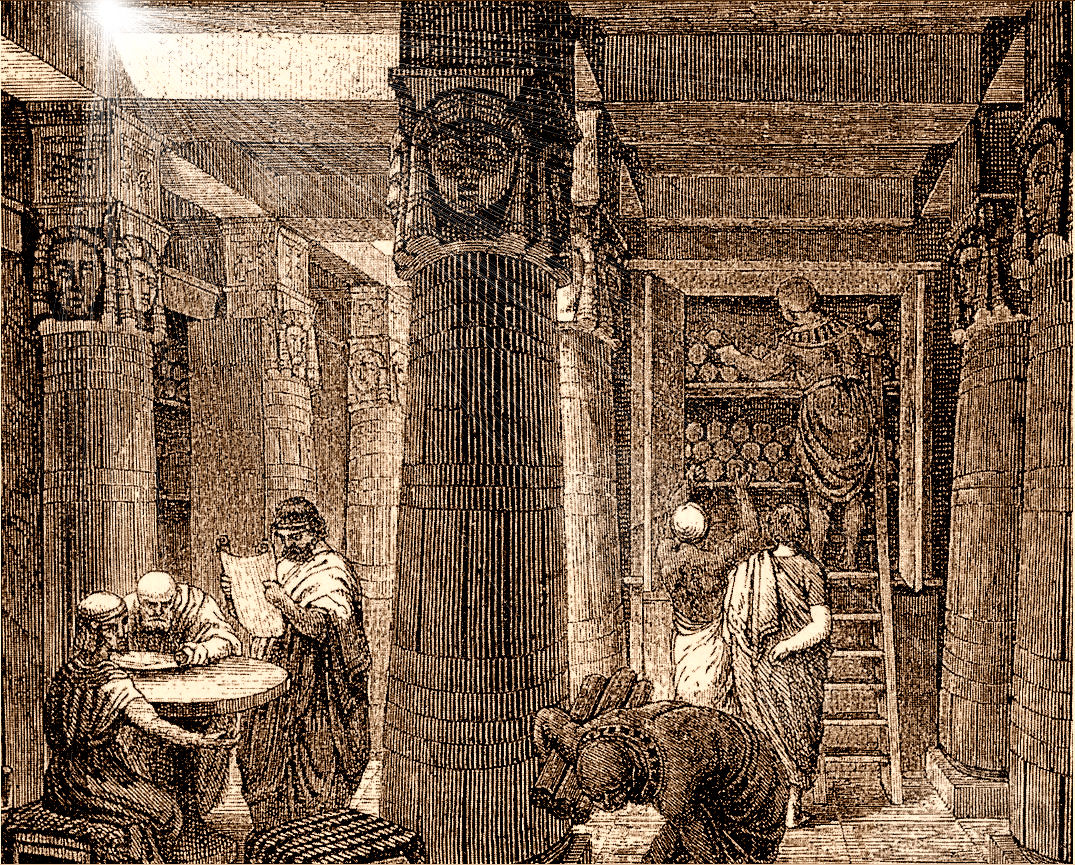
Although it wasn’t a technology, the legendary Library of Alexandria warrants a place on this list, if only because its destruction meant that so much of the collected knowledge of antiquity was forever lost. The library was founded in Alexandria, Egypt in roughly 300 B.C., most likely during the reign of Ptolemy Soter. It marked the first serious attempt to gather all the known information about the outside world in one place. The size of its collection is not known (though the number has been estimated to be in the neighborhood of one million scrolls), but the library undoubtedly attracted some of the great minds of its day, among them Zenodotus and Aristophones of Byzantium, both of whom spent considerable time doing scholarly work in Alexandria. The library became so important that there is even a legend that all visitors to the city would have to surrender their books upon entering so that a copy could be made for storage in the great library.
How was it Lost?
The Library of Alexandria and all its contents burned sometime around the first or second century AD. Scholars are still uncertain just how the fire was started, but there are a few competing theories. The first, which is backed up by historical documents, suggests that Julius Caesar accidentally burned the library when he set fire to some of his own ships in order to block the path of an advancing enemy fleet. The fire spread to the docks and then enveloped the library. Other theories contend that the library was sacked and burned by invaders, with the Emperor Aurelian, Theodosius I, and the Arab conqueror Amr ibn al ‘Aas serving as the main contenders. However the Library of Alexandria was destroyed, there’s little doubt that many of the secrets of antiquity were lost along with it. We’ll never know for sure just what was lost, but had it remained standing, there’s an argument to be made that many of the technologies on the list would have never been lost.
5. Damascus Steel

Damascus steel was an impossibly strong type of metal that was widely used in the Middle East from 1100-1700 AD. It is most famously associated with swords and knives. Blades forged with Damascus steel were known for their amazing strength and cutting ability, and were said to be able to slice rocks and other metals—including the blades of weaker swords—cleanly in half. The blades are believed to have been created using wootz steel, which was most likely imported from India and Sri Lanka and molded and blended to create a patterned blade. The special quality of the swords is thought to have derived from this process, which weaved together tough cementite and soft iron to form a metal that was as strong as it was flexible.
How was it Lost?
The particular process for forging Damascus steel appears to have disappeared sometime around 1750 AD. The exact cause for the loss of the technique is unknown, but there are several theories. The most popular is that the supply of ores needed for the special recipe for Damascus steel started running low, and sword makers were forced to develop other techniques. Another is that the whole recipe for Damascus steel—specifically the presence of carbon nanotubes—was only discovered by accident, and that sword smiths didn’t actually know the technique by heart. Instead, they would simply forge the swords en masse, and test them to determine which met the standards of Damascus steel. Whatever the technique, Damascus steel is one technology that modern experimenters have been unable to fully reproduce. There are pattern welded knives that are marketed as being made from “Damascened steel”, but while usually well made, they are only approximations of the lost technique for real Damascus steel.
4. Apollo/Gemini Space Program Technology

Not all lost technology dates back to antiquity—sometimes it’s just become so obsolete that it’s no longer compatible. The Apollo and Gemini space programs of the 50s, 60s, and 70s were responsible for NASA’s biggest successes, including some of the first manned space flights and the first trip to the moon. Gemini, which ran from 1965-66, was responsible for the much of the early research and development into the mechanics of human space flight. Apollo, which followed shortly thereafter, was launched with the goal of landing a crew on the surface of the moon, which it succeeded in doing in July of 1969.
How was it Lost?
The Apollo and Gemini programs aren’t truly lost. There are still one or two Saturn V rockets lying around, and there are plenty of parts from the spacecraft capsules still available. But just because modern scientists have the parts doesn’t mean they have the knowledge to understand how or why they worked the way they did. In fact, very few schematics or records from the original programs are still around. This lack of record keeping is a byproduct of the frenetic pace at which the American space program progressed. Because NASA was in a space race with the USSR, the planning, design, and building process of the Apollo and Gemini programs was always rushed. Not only that, but in most cases private contractors were brought in to work on every individual part of the spacecraft. Once the programs ended, these engineers—along with all their records—moved on. None of this would be a problem, but now that NASA is planning a return trip to the moon, a lot of the information about how the engineers of the 1960s made the voyages work is invaluable. Amazingly, the records remain so disorganized and incomplete that NASA has resorted to reverse engineering existing spacecraft parts that they have lying around in junkyards as a way of understanding just how the Gemini and Apollo programs managed to work so well.
3. Silphium

Lost technologies aren’t always the result of too much secrecy or poor record keeping—sometimes nature just doesn’t cooperate. This was the case with Silphium, an herbal wonder drug that the Romans used as one of the earliest forms of birth control. It was based on the fruit of a particular genus of the fennel plant, a flowering herb that only grew along a certain shoreline in modern day Libya. The heart-shaped fruit of the Silphium plant was known to be something of a cure-all, and was used to treat warts, fever, indigestion and a whole host of other ailments. But it was Silphium’s powers as a contraceptive that made it one of the most valuable substances in the Roman world, to the point that the plant appears on several different pieces of ancient Roman currency. Women would drink Silphium juice every few weeks, and this would be enough to prevent pregnancy. Using the herb would even terminate an existing pregnancy if used correctly, which would make Silphium one of the earliest methods of abortion.
How was it Lost?
Silphium was one of the most sought after drugs of the ancient world, and its use spread rapidly across Europe and into Asia. But despite its remarkable effects, the particular genus of plant needed would only grow in one area along the Mediterranean in North Africa. Its scarcity, combined with an overwhelming demand, more than likely led to over harvesting, which drove the plant into extinction. Because the particular species no longer exists, modern scientists are unable to examine Silphium to see if its powers of contraception were really as effective as Roman historians and poets would lead one to believe, or if there were any adverse side effects. Still, it is worth noting that other herbs that are chemically similar to Silphium have been proven to have a fairly high rate of preventing pregnancy.
2. Roman Cement

Modern concrete was developed in the 1700s, and today the simple mixture of cement, water, sand, and rocks is the most widely used building material in the world. But the recipe developed in the 18th century wasn’t the first time concrete was invented. In fact, concrete was widely used throughout antiquity by the Persians, Egyptians, Assyrians, and Romans. The Romans in particular made extensive use of concrete, and they were responsible for first perfecting the recipe by mixing burnt lime with crushed rocks and water. Their mastery of its use allowed them to build many of their most famous structures, among them the Pantheon, the Colosseum, the aqueducts, and the Roman Baths.
How was it Lost?
Like so many technologies of the Greeks and Romans, the recipe for concrete was lost during the descent into the Dark Ages, but just why remains a mystery. The most popular theory is that the recipe was something of a trade secret among stonemasons, and that the method for making cement and concrete died along with those who knew it. Perhaps even more interesting than the disappearance of Roman cement are the particular qualities that separate it from more modern Portland cement, which is the most common type of cement used today. Structures built with Roman cement, like the Colosseum, have managed to weather thousands of years of punishment from the elements and remain standing, but buildings constructed with Portland cement have been known to wear down much faster. This has been theorized to be the result of different chemicals that the Romans added to their cement, among them milk and even blood. These were said to create air bubbles within the concrete that helped the material to expand and contract in the heat and cold without damaging itself.
1. Greek Fire

Perhaps the most famous of all lost technologies is what is known as Greek Fire, an incendiary weapon that was used by the military of the Byzantine Empire. A primitive form of napalm, Greek Fire was a kind of “sticky fire” that would continue burning even in water. The Byzantines most famously used it during the 11th century, when it was credited with helping to repel two sieges of Constantinople by Arab invaders. Greek Fire could be deployed in many different ways. In its earliest form it was poured into jars and thrown at enemies like a grenade or a Molotov cocktail. Later, giant bronze tubes were mounted on warships, and siphons were used spray the weapon at enemy vessels. There was even a kind of portable siphon that could be operated by hand in the style of a modern flamethrower.
How was it Lost?
The technology behind Greek Fire certainly isn’t completely alien. After all, modern militaries have now been using similar weapons for years. Still, the closest counterpart to Greek Fire, napalm, wasn’t perfected until the early 1940s, which would mean the technology was lost for several hundred years. The weapon’s use seems to disappear after the decline of the Byzantine Empire, but just why still isn’t known. Meanwhile, the possible chemical composition of Greek Fire has been widely studied by historians and scientists. An early theory was that the mixture included a heavy dose of saltpeter, which would make it chemically similar to gunpowder. This idea has since been rejected, because saltpeter wouldn’t burn in water. Instead, modern theories propose that the weapon was more likely a cocktail of petroleum and other chemicals, possibly including quicklime, niter, or sulfur.
74 Comments
I know I am super ridiculously late to the party, but using only Europe and the USA? Ouch. One good lost tech that we reinvented was chrome. Made in the 1930s I believe, only for us to find out China invented and lost it first 2,000 years earlier. Want to know how a lot of tech gets lost? Absentmindedness or just plain evil jerks, such as Tiberius of Rome who murdered the inventor of flexible glass so that silver and gold prices wouldn’t be undermined. Mithridate cure for poison lost in a sort of telephone game as translations kept leaving off or changing its 65 ingredient composition. You can thank the FDA for obliterating all sorts of cures and treatments and technologies via bribes, threats, or downright theft in order to remain dominant. Also gotta love family lines that take their secrets to the grave.
#4 is completely false, the science and engineering behind the us space program is not only known, but also practiced. to think the engineers built a rocket that took man to the moon, and that they never knew how it worked is ignorant
The title of this video is “10 Lost Technologies”, so why are a number of things in this video not technologies (like Atlantis) or not lost (either because we know how they worked, like Damascus Steel and the Antikythera Mechanism, or because they’re mythical with no basis in fact, like Atlantis and Vimanas)??
GOOD.
I wouldn’t dispute that the reputation of the Stradivarius violins is overrated – it’s hard to imagine how it wouldn’t be. But that study doesn’t preclude the assertion that the Stradivarius violins were at least somewhat better than other violins of its time or even of those made relatively recently. That’s where the unusually dense wood – a byproduct of the particular time and place in which it was made – might be a factor.
Nice article, but not one mention of Nikola Tesla? Really?
yeah and what about the ancient indian technology to produce rust free iron???
Is it only about the technologies of Europe ….why there is no mention of the great asian technologies?? and by the way mentioning the greek fire as no. 1 make no sence cause it was used only for distructive purposes or so
We are often accused of being biased to the USA, this is our first complaint about being biased towards Europe. I guess this means we are offending more people than ever. 😉
What? No mention of Tesla’s technology?
Only partial truth on the NASA loss of schematics and other documents surrounding the Apollo and Gemini programs. A HUGE number of documents and hand drawn schematics still existed into at least the late 1970s, but the contractor companies were having to pay to store them – I mean store huge rooms full of documents (ie, very expensive). They kept asking NASA to either move the docs somewhere or foot the bill for their storage, and NASA didn’t. Eventually they told NASA they were going to destroy them all by a particular date if nothing was done, and nothing was done, so they were destroyed. Yes, really. Dad was really ticked when they did they – everybody at Marshall Space Flight Center (and presumably the other centers as well) knew about it, but nobody had budget to convert it all to microfilm nor space to keep the originals, so they were trashed. Sad, eh?
Of all top ten i rate of all the Alexandria library cause it contained majority of this in his rich archives, so major of all loses is Alexandria library which many of early civilizations vanished together with its records.
Monster beat, what evidence do you have for this hypothesis? Moreover, what the hell does it have to do with anything in this article? If I had to guess, Khomeini was afraid of what Reagan would do and thought Carter was a wimp (right on both counts). Qadafi had to learn the hard way.
I agree that many of the items on this list do not qualify as technology, but are nonetheless interesting.
Michael, why do you lead in with the Germ Theory of Disease when you know as well as I do neither Palin nor any of her contemporaries deny it. I suppose you mean to make her look ridiculous, and thus equate that with questioning evolution. Questioning gravity? Sorry, never happened. I think you sandwiched evolution in there to give it greater credibility than it deserves. I have no religious objection to evolution per se, but there are just too many holes in it for me to be comfortable endorsing it as accurate. Just having an understanding of all of the changes happening on a nigh-constant basis to the classification system makes me wary of assuming relationships between organisms, alive or extinct. Assuming that any fossil (or tiny fragment of a fossil) that in any way resembles something primate is an ancestor of Man is statistically ridiculous, even if you assume evolutionary theory to be accurate. Both gravity and germs can be observed and verified under laboratory conditions. Interspecies evolution cannot. All species change a bit from generation to generation; I’m a little taller than my dad. Still, they don’t change into new species. As for sub-species, those are known as breeds or races. Yes, there are many races of men. Insisting that this is evolutionary in nature implies that some might be more advanced than others, which is how many racists justify their hatred. If, after all, sub-species become new species, and we ascended from simpler into more complex lifeforms, we assume that further evolution is an advancement. Since evolutionary scientists claim that the human species originated in Africa and that the other races evolved as groups left Africa, it would imply that Africans are less evolved. This, in my view, is racism. I cannot endorse it.
Let us not forget that Reagan’s future vp (Bush) and cia chief (Casey) met with the Ayatolla Khomeini behind the back of the then-current Carter administration (treason) and arranged for Iran to keep the American hostages until after the election. In return Iran got, at the very least, a conduit thru which to illegally receive missiles and other armaments–which came to light when traitor Ollie North got busted taking the missile $$$ and giving it to friends in Central America who turned out, naturally enough, to be drug smugglers USA-bound. Ah, the good old days…
Silphium (or Laserpicium, sometimes just called laser) did not go extinct or was not revered primarily because of it’s use as an abortifacient (in fact, the only mention of its use in this manner was by Pliny). It was used in medicine but more often it was used as the main spice in cooking. It was highly prized by top cooks and the wealthy demanded it to season their meals. The oldest known cookbook, titled Apicius after Marcus Gavius Apicius, uses laser in the majority of its recipes.
It became very expensive because it was over-farmed and they were unable to cultivate it. Caesar Nero is rumored to have eaten the last known sprig of laser.
Today the resin asfoetida is considered to have the closest taste to that of laser.
All the old technologies are interested to see and it was very bad that some of them are lost now-a-days. Especially the library of Alexandria.
Thanks for the good read. What are some of the plants that are related to Silphium?
Another interesting “lost technology” is the cure for Scurvy. This article about it is fascinating – http://idlewords.com/2010/03/scott_and_scurvy.htm
I once saw an interesting blind test of violins. Several experts were blindfolded and listened to a group of violins and asked to identify which was the strad. Not one of them got it right.
It’s “hypothesis” not “theory”.
Why is that important? It’s important when the Palin crowd wants to dismiss the Germ Theory of Disease, The Theory of Evolution, The Theory of Universal Gravitation, etc. by saying “But it’s just a theory”.
Don’t forget Fogbank…
http://www.foxnews.com/story/0,2933,507305,00.html
I know I’m a little late in posting a response to this great list, so it will probably never be read, never-the-less I have to say this: Nepenthe is Marijuana, case closed.
DUUUUUUUUUDE You just found that technology. LOL hiding in our own ashtrays.
I read up on damascus steel somewhere that back in those days the blades were so strong because certain molecules in the smoke in what they were burning to forge the metal were weaved in to the blade. The guy who discovered this actually just got a Nobel prize
All it was was carbon and occasionally they got naturally formed carbon nanotubes in it. It’s called carburizing and is still a common heat treat process for lower carbon steels. It was the way they did it more than anything else that made it better.
a little research on damascus steel will show you that shotguns were made from it in the early 1800s into the 1900s.Shotgun shell boxes of modern ammo used to have warnings on them not to use in damascus barrels because they were inferior steel and may explode.Not hardly the fine steel your article claims.
Nice, I just wanted to write the same thing. In my hunting class they still had some damascener stell guns to show us how they looked so we would know not to use them anymore.
Damascus even today more typically refers to layered steel created for aesthetics. They are two different things.
Damascus steel only works well when used in the right way, for swords. Not for looks, as in the shotguns. The layers have to be perpendicular to the force applied, and the flexibility in the other direction makes it more resistant to breakage.
If not maintained, it could oxidize between the layers and weaken, causing the shotgun to fail.
A great list for idiots who do research on wikipedia…. Most of the items presented here are well understood curiosities, and from what I understand- none are “lost technologies.”
#10 – Nitre is saltpeter
Great stuff Mr. Andrews, keep em' coming. Don't pay attention to that doosher Charlie up there. It's a lot easier to criticize work than it is to create a top ten.
The technology of the Antikythera Mechanism wasn't lost; it was just the Ptolemaic model of celestial bodies. And the mechanism has been completely reverse-engineered and reproduced; see the description in a recent issue of Scientific American.
"Like so many technologies of the Greeks and Romans, the recipe for concrete was lost during the descent into the Dark Ages"
There is no such thing as "Dark Age"; this is a myth perpetuated by Victorian historians who viewed the middle ages with scorn. The medievals built universities, financed astronomy, Advanced medical discoveries, rediscovered the Classics, and formulated some of the most sophisticated philosophical systems/arguments.
Sociologist Rodney Stark has written extesively on this subject.
Dark Ages are the time, most specifically in greater Europe after the fall of the Roman Empire. When the empire fell, the continuous spread of knowledge and economic wealth fell of drastically. Societies changed and Christianity prospered. Ancient knowledge tapered off and quickly political and religious powers were bound together and created a submissive society. There no longer existed creative freedom as before and “advanced” medical discoveries consisted of first weighing your spiritual health and applying the appropriate remedy. There were hospitals, but they were in part designed as quarantine during the plagues. There were no actual advancements until later. Religious oppression grabbed hold then, and since has refused to let to even though the world has changed.
Got original sources for that? No? Didn’t think so.
As most educated people know, the Eastern Roman Empire didn’t fall and Greek knowledge was preserved in the Monasteries, every text we have was copied down at some point by a monk.
Politics and religion were quite entwined in the Roman world, emperors were ascribed divinity, and it was a bishop called Ambrose who forced a Roman emperor to repent of murdering 5000. Rome had a slave society, which is a pretty submissive way to be.
Sure, there’s lots of sources out there. Check out Wikipedia for a start as they list sources and is a pretty good place to start.
Quick wiki search found “decline of the roman empire” and “medieval medicine”
The Byzantine empire is not the Roman empire. Some knowledge was preserved, but most lost. And as you pointed out, that knowledge was preserved in monasteries, out of the hands of the people and preserved in the monarchy. People got so caught up in religion and gave up on society. They were all waiting to be saved and go to heaven.
Rome had an ordered society, that worked.
http://www.rome.info/history/empire/fall/
Funny how many of the ingredients in Rome’s fall are present in modern America.
http://en.wikipedia.org/wiki/Decline_of_the_Roman_Empire
You invoke a monocausal explanation for the decline of Western Rome. Even Wikipedia acknowledges that there are many schools of thought on that. Not least that Rome was in decline long before Christianity had made any significant inroads into society.
http://en.wikipedia.org/wiki/Dark_Ages_(historiography)
http://en.wikipedia.org/wiki/Early_medieval
Strangely enough, many scholars dispute whether the term “dark age” should be applied to the Early Medieval Period, except in regards to the lack of written history coming out of that time. A paucity of literature and cultural artifacts do not a “dark age” make. The pejorative form, implying that they were periods of ignorance and superstition, is long gone from scholarly circles.
From the wiki.
“[M]isconceptions such as: “the Church prohibited autopsies and dissections during the Middle Ages”, “the rise of Christianity killed off ancient science”, and “the medieval Christian church suppressed the growth of natural philosophy”, are all cited by Ronald Numbers as examples of widely popular myths that still pass as historical truth, although they are not supported by current historical research.”
http://en.wikipedia.org/wiki/Byzantine_Empire
http://en.wikipedia.org/wiki/Byzantine_medicine
For as long as the Byzantine Empire existed they considered themselves Romans of Rome. The article on medicine says that, contrary to your claims, the Byzantines did make advances in medicine over the Greek traditions they inherited. In Constantinople in the twelfth century they had two hospitals, staffed by doctors (including women) trained in the University of Constantinople which were places which practiced systematic treatment, with separate wards based on disease.
Do you actually read the articles you tell others to read? History is far more complex than the simple black and white you try to paint it.
Greek fire was used in the early 8th century during the two Arab sieges of Constantinople, not the 11th as stated in the article.
Also, as for the hippie whining about it, Greek fire saved Western civilization from Islamic conquest…so piss off!
Not to mention that it was never actually lost – I have two different recipes, one Rennaissance, laying around somewhere.
Interesting. I worked on Gemini and Apollo as a NASA employee in Houston, and later on the design of the space shuttle as an engineer in industry. It seems to me that the “lost technology” tends to fall into two categories: (a) the specific rationale for a particular design or way of doing things; and (b) how to design, manufacture and qualify HIGHLY reliable mechanical assemblies.
Examples in (a): the design of the Apollo lunar rendezvous operational plan; the specific architecture of the shuttle orbiter avionics system. Examples in (b): the Gemini reaction control system (RCS, which initially gave a lot of trouble); the Apollo lunar module ascent and command module service propulsion system engine assemblies (no backup, can’t get home without them).
I think the authors are giving NASA too much credit. I'd heard from several sources that the plans for the Saturn V rocket, were given away to a Boy Scout paper drive. The story went on that the intention was to make very sure that nobody tried to backtrack on the Shuttle program.
So, the plans weren't lost; they were thrown out.
Has anyone else heard anything along those lines?
Interesting. I worked on both Gemini and Apollo as a NASA employee In Houston. I think the technology which has been mainly lost falls into two categories: (a) the rationale for doing or designing things in a certain way; and (b) how to design and manufacture complicated mechanical assemblies that are HIGHLY reliable (at least for 7-10 days).
Examples in (a): the design of the Apollo lunar rendezvous profile; the exact form of the avionics architecture for the Space Shuttle orbiter. Examples in (b): the Gemini reaction control system (RCS, which initially gave a lot of trouble); the Apollo lunar module ascent engine assembly.
Regarding Stradivaris, take it from a professional violinist: Yes, Stradivaris are great! If played (extremely) well they sound unbelievable. I would love to have one. Well, at least my teacher at university let me try his.
But there are quite some violin makers whose instruments are on par with Stradivaris, the best example is the Guarneri family especially Guarneri del Gesu. Search for his "Il Cannone". If could get just one violin I would get this one.
Even if the "secrets" of Stradivari seem lost nowadays you can find mdern instruments who really can compete with Stradivari's violins, they just are not as expensive and are – because of this – no status symbols. Christian Tetzlaff, one of the world's leading violinists, who owns a Stradivari quite often leaves it at home, because his modern violin, built as a copy of his Stradivari by the german violin maker Greiner, sounds just as well and is nowhere as sensitive to changes in climate and humidity. Finicky instruments can really be a pain if there is a concert and your violin just doesn't feel like it today.
Two 'technologies' that were also lost were the blue the Chinese used to make the blue in 'famille vert' porclain, a distinctive blue and the method for making Russian leather, considered the finest leather in the world and worth fortunes in the 19th century.
this is so true ;O
It really seems the Top 10 Lost Technologies could aptly be re-titled as Cool Stuff White People Thought of and Lost Somehow. I mean come on, throw the coloureds a bone here. I'm sorry, you did. #9 starts off by marveling at the genius of ancient europe's beacon of light and aspiration towards civilisation, "The sheer sophistication of the technology wielded by the ancient Greeks and Romans is often quite astonishing,…" But it is later revealed rather slyly that, "Nepenthe was said to have originated in Egypt,…"
Never mind that the civilisations of KMT, Kush, Axum and Nubia ALL pre-date europe's best attempts at civilised living by thousands of years. Never mind that the greeks and romans literally studied at the feet of these societies for hundreds of years but could not sustain their own ambitions for civilisation for a fraction of the duration of the civilisations of their teachers.
Sometimes I want to give you all the benefit of the doubt, maybe the illusory farce of white supremacy is wearing off and you all will soon begin to see clearly. But time and time again I am brought back to this shanty reality.
Real class act you guys.
The article mentions coloureds a lot.
Damascus Steel was invented by Arabs and obviously forged with materials from India and/or Sri Lanka..
The library of Alexandria was in Egypt.
Silphium only grew in Libya which is in the Middle East.
Greek Fire was used in the Byzantine Empire which is in the Middle East as well.
Cement was not only used by Romans, but also by Persians, Assyrians and Egyptians.
I’d have thought the pyramids and several other wonders of the world should have been included.
Didn’t Julius Caesar think the Celts believed the sky was falling on them?
A much vaunted forgotten book on rocket science written in the 17th Century proved them correct meanwhile excerpts from the book are being rediscovered as new physics makes the repeat discovery.
What was understood by the Music of The Spheres, could it have been planetary and stellar magneto-spheres?
Or was it just astrological mumbo jumbo?
(My field, that one. If anyone has any idea, please feel free to contact me.)
Apparently modern medicine is based on American Indian medicine. One student even succeeding in its use to treat cholera.
What happened to the recipe for creating the first platinum crucibles?
What was lost to the NASA when it scrapped all its card readers for the gold in them and promptly lost all the data the cards held but nobody could read?
There are plenty of stories of successful technologies where secrecy was worth more than a patent.
That's just sad – what have "you" done in the last 2,000 years that isn't disastrous?
The assertion that the Telharmonium's "massive energy consumption strained early power grids" is not the case. The second Telharmonium (operated in New York from 1906 to 1908) was powered by a 185-hp DC motor. Since most of the alternators at any given time were on open circuit, the load on the motor averaged only about 100 hp. This was not a large power draw and was easily supplied to Telharmonic Hall. The main reasons for failure on the demand side were that (1) the instrument could only create the sounds of an organ, though it was promoted as replacing an orchestra, (2) the sound quality was somewhat annoying, and (3) experimental broadcasts were heralding the advent of radio which could offer speech and song, whereas the Telharmonium was strictly instrumental. See my book "Magic Music from the Telharmonium" (Scarecrow Press, 1995).
Two major quibbles, one of which you acknowledge already right in the article:
(1) Although the loss of the library at Alexandria was a tragic blow to the advancement of human knowledge, it is, as you pointed out right at the top of that section, not a technology. Should've been a footnote or afterword, with something else taking its place in the list.
(2) Although all three Telharmonia are lost, the technology of the Telharmonium is not — it's the same technology used in the Hammond electric (not electronic) organs that were so important to the sound of 1960s and 1970s popular music (e.g. the Hammond B3 and M3). I don't know of any still being built (the Hammond X3 emulates the sound of the earlier tone-wheel organs electronically), but plenty of tone-wheel Hammonds are still around, still being played.
The tone-wheel electric organ is a fascinating technology (or at least I think so, though perhaps the folks I frequently babble to about it are bored), but not yet lost.
Great list! I found it astonishing & sad that some of this knowledge is lost. When I visited Savannah, the guides said that both the recipe for the famous Savannah bricks & the recipe for the unusual pavement made from burnt/crushed limestone/shells had been lost shortly after the Civil War.
You forgot the Apple PowerBook Duo and its dock!
really cool !!!
I pearsonaly think that the orignal katana should be on the list. It was the most well crafted sword in history and we have no idea the process of making it.
The original art wasn’t lost and its still practiced today. They would put in several hundred folds in the metal while forging it on human bones. I wish i could remember the name of the documentary i watched about it, but you can still get one crafted, you can commission a sword to be made with you bones when you die. you should be able to find the documentary about it fairly easy though.
your silly digg/redit/su/buzz/whatever bar blocks the entire left hand side of the article. Way to put off a potential reader!
What browser are you using. I don't see any issues and I have checked with mac and pc on all browsers. Does it happen all the time?
This is a terrible list! Half of the things aren't technologies and the other half are vague and pointless. I mean, napalm as your number one lost technology of all time? Why! How about the steam power the Greeks they never bothered to convert into engines instead?
I'm going to break it down here:
–Not a technology: Library of Alexandria (Although tragic), Greek anti-depressants, Stradivarius violins (It was the wood! there's no lost technology!) Roman birth control (Although so highly useful for womens emancipation and stuff it probably does deserve it's place here.)
—Boring/Disturbing: Teleharmonium (Such an odd thing to put down, why not substitute for any one of the works of Nikolai Tesla that was lost when his laboratory burned?) Greek Fire (Apart from it being on fire and cool, why is a brutish instrument of mass death any loss to humanity?)
—Interesting and relevant: Damascene Steel, Antikythra mechanism, Roman cement, Apollo stuff.
Sorrry, but make it called 'Six Great Losses to Humanity and Technological Development' and take out everything I've slated and your list would be fine. (As the name change lets you keep the Library and the Silphium)
cool list, fun fact about the Stradivari Violins.
Alot of these relics have been found now to not be crafted by the Stradivari family.
But OTHER craftsmen who admired the talent/skill of the Stradivari violins would attempt to copy the method and label it Stradivari as an homage and to give credit to the family.
therefore many of the supposed violins are copies themselves and not the real deal.
You’re referring to the international effort in the 1940s & tos to study every Strad for authenticity. It was fond that 8 out of 10 were fakes. Fraudulent makers are common in all fields of art, but that doesn’t mean the originals were not unique. Provenance records are the final proof of origin.
Strad made exceptional instruments in his shop, with a team of assistants that included his sons, and students who became brilliant makers on their own. That was haw a makers shop worked, with apprentices carefully following the masters Instruction. They weren’t “other makers”, they were the staff that helped him become the most famous maker of his day.
Just like Rembrandt or Picasso, fakes abound, but Straivari instruments are still original works of genius.
good article!! informative
Good article. One of the more interesting ones I have read. I would like to see more articles like this one. Kudos to you author.
About #5, the Damascus Steel… It was discovered what made it stronger back in mid-late 1950s actually. The process of forging Damascus Steel included cooling the blade by plunging it into a prisoner or an animal they were slaughtering. In the mid 1950s, a metallurgist (who's name escapes me right now) decided to try cooling the steel blades by plunging them into cow hides. He wound up with strengthened steel that he attributed to various micro-organisms that strengthened the steel. In 2006, researchers at Technische Universität Dresden proved this correct and further explained that the micro-organisms caused the formation of the carbon nanotubes and cementite nanowires that give Damascus Steel its strength.
Got a source? Your comment made me curious to know more, but I can't find anything exactly related to your claim.
The Wikipedia section talking about the Dresden study says, "This section appears to contain speculation and unjustified claims."
A Nation Geographic article in 2006 says the Dresden study is speculation, and doesn't mention prisoners or slaughtered animals.
http://news.nationalgeographic.com/news/2006/11/0…
And this page, Paufler (one of the Dresden researchers) himself says, "At high temperatures, the impurities in the Indian ores could have catalysed the growth of nanotubes from carbon in the burning wood and leaves used to make the wootz, Paufler suggests. These tubes could then have filled with cementite to produce the wires in the patterned blades, he says."
http://www.nature.com/news/2006/061113/full/news0…
Sounds like he's attributing the nanotubes to the impurities in the wootz steel and the forging process, not the cooling process. This agrees with how the list is originally written.
Awesome list by the way. One of the best on the site!
The whole article about damascus steel is wrong. Wootz and damascus are two completely different things. Wootz is made by smelting ore in a crucible and then flattening it out. The lines in the steel are created by martensite distorting the grain. This was a Perzian technique and is still very much alive. It has been rediscovered many years ago.
Damascus steel has nothing to do with its metallurgical properties. It is just a name for a forge welding type that originated in the city of damascus. Modern blacksmith are perfectly able to craft patternwelded blades that match even the most precious of old damascener blades. The myth of quenching blades in a slave is just that: a myth and I can assure you that micro organisms in the quenching medium have no influence whatsoever on the hardnes or tensile strenght of a blade. The only thing that really influences steel is it's temperature and the period at wich certain temperatures are maintained. I'm a Belgian blacksmith myself and the techniques to create wootz, damascus and pattern welded blades is very widely practised. In the USa the ABS can give you more info on the subject.
Great list, very interesting!
Been following the site for some time and this is the most interesting article so far, good job!
Particularly liked the number 10th, one of my life goals is to get my hands on one of those violins… the biggest problem is that even after acquiring the inordinate amount of cash I would still have to find one that is for sale ><
…on a second thought, it would probably sit under my desk for years and years without a single play session, perhaps it's best to drop this dead and instead pursue the recreation of number three!!! I am sure I would be able to buy all Stradivari's in the world if I managed that ^^
Great list Evan Andrews. Some say James Black the creator of the original Bowie knife knew the secret to Damascus Steel. http://en.wikipedia.org/wiki/James_Black_(blacksm…
Great list. Imagine if the library at Alexandria had not burned, what treasures of knowledge we would have! And the Antikythera Mechanism indicates a knowledge of technology that we never knew about the ancients. Fascinating!
http://www.youtube.com/watch?v=RLPVCJjTNgk
So interesting 🙂
I would like to comment on the people making and reading the article-that the fact that Amr bin Al As used to be one of the contenders in burning of Library nof Alexandria is not accurate at all.There is no strog evidence for it. I am a student of history and there has to be no such thing mentioned.