

The final resting places of most historical figures are highly guarded and viewed by many as shrines or at least veritable cash cows for the societies guarding them. For a very few of those figures, some of their remains have been “preserved” for posterity, the sake of science or just egotistical reasons. Sure anyone can see a dinosaur bone in a museum, but wouldn’t you rather see the brain of a famous scientist or the shattered bone of a martyred revolutionary?
The order of this list was derived from the relative popularity of the dead historical figure along with the circumstance of how or why the “artifact” was preserved.
10. Dan Sickles’ Leg

A Union general who lost his leg to a cannon at the Battle of Gettysburg, Major General Dan Sickle was not a brilliant man. After seeing high ground in front of his troops, he ordered them to move about a mile away, which was more indefensible and where they were effectively decimated. His leg was hit by a cannonball and had shattered, but he persevered until his leg was amputated that afternoon. Sickles’ leg and the cannonball are displayed at the American National Museum of Health and Medicine since he remembered that the Army Surgeon General was building a display of morbid anatomy along with the projectiles that caused it. Too bad this insubordinate’s legacy lives on because of that directive.
9. Del Close’s Skull

While Del Close had taught many improvisational giants in modern media such as Stephen Colbert, John Belushi, Tina Fey, Harold Ramis, Bill Murray and others, it was perhaps his final request that wound up being the cruelest joke. Close has wanted his skull donated to the Goodman Theatre in Chicago so he could play Yorrick in “Hamlet.” While his creative partner Charna Halpern tried to make it happen, no medical organization would allow his skull to be separated from his head due to funding and/or ethical concerns. So Goodman Theatre has a stand-in while Close’s skull was cremated along with the rest of the body, according to Halpern.
8. Major John W. Powell’s Brain

This Major is the second American Civil War soldier on this list, though he only lost an arm in the war. John Wesley Powell was the founder and longtime director of the Bureau of American Ethnology though he was arguably most famous for his exploration of the Colorado River and the Grand Canyon post-Civil War. The first of three brains on this list, Powell’s is on display in a vat at the Smithsonian institute.
7. Paul Broca’s Brain

French physician and anthropologist Paul Broca is best known for his mid 1800s discovery of the speech production center of the brain in the frontal lobe. In addition to that area being named after him, he also famously founded a number of anthropological societies in France and beyond. Wonder what he would have to say about his brain being a display at the Museum of Man in Paris?
6. José Rizal’s Vertebra

José Rizal’s execution sparked the revolution of his homeland, Spanish colonial Philippine in 1896. Like Gandhi, Rizal believed in peaceful means to reform, which was what he wanted for his country. Now a national hero, he was originally buried in non-blessed grounds in an unmarked burial site. But about 17 years after his death his body was exhumed and transported to Luneta. During the transport a single vertebra was enclosed in a glass reliquary for display, eventually, at the Rizal museum in Fort Santiago. Supposedly it was the only bone hit by the single live bullet of the firing squad when he was executed.
5. St. Bonaventure’s Arm
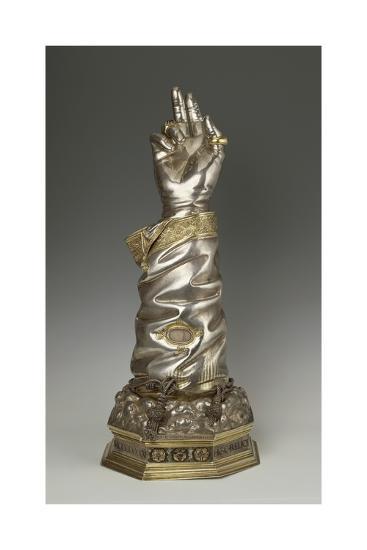
Our only holy figure on the list, this saint’s writing arm and hand have been preserved due to his work “Commentary on the Four Books of Peter Lombard.” St. Bonaventure’s arm was encased in a silver arm-shaped reliquary that now resides in his hometown of Bagnoregio, in the parish Church of St. Nicholas. Called a Seraphic Doctor by his colleagues, this 13th century Franciscan monk postulated that no ideas existed in nature, that they were all given to human through the Divine; hence writing by the hand of God!
4. George Washington’s Hair

The father of the American nation, George Washington’s death was mourned by everyone in the United States. However, it was the aunt of Henry Wadsworth Longfellow who asked for a lock of his hair in remembrance of the great man. In 1850, Longfellow had the lock of hair enclosed in a gold locket, which was later given to the Maine Historical Society per his aunt Eliza Wadsworth’s wishes.
3. Lazzaro Spallanzani’s Bladder

Italian biologist Lazzaro Spallanzani was best known in the 1700 as paving the scientific highways for Louis Pasteur by proving that microbes traveled by air and could be killed by boiling – like most other living organisms! He also proved that sexual reproduction in mammals requires a sperm and an ovum, and performed the first successful artificial insemination … on a dog. But his bladder was supposedly the most useful part to be preserved since he died from bladder cancer. Spallanzani’s bladder remains on public display in a Pavia, Italy museum.,
2. Galileo’s Finger

Galileo Galilei has been called the father(s) of “modern science,” “observational astronomy” and “modern physics.” He has a list of accomplishments as long as his arm, though his arm and fingers were under house arrest by the Inquisition during his last years of life due to his belief that the sun was the center of the universe, not the Earth. Of course when he died, his body wouldn’t remain at his house and his finger didn’t remain with his body either. Galileo’s finger is on display at the Museo di Storia del Scienza in Italy after it was removed by Anton Francesco Gori in 1737. Just shy of a century after his death, Galileo’s body was transferred from a small closet to a newly built mausoleum.
1. Albert Einstein’s Brain
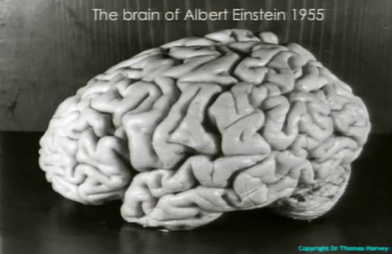
Like many other geniuses, Albert Einstein’s extraordinary intellect was always questioned – why was he so intelligent? After his death in 1955, Einstein’s brain was extracted from his body by Princeton Hospital pathologist Thomas Stoltz Harvey without the permission of Einstein’s family. Ostensibly, Harvey told the family that he would try to have it examined; it was examined once over the next 40 years, but those results were highly questionable according to the scientific community. To this day, no conclusive research has been done on Einstein’s brain, which has also not remained whole due to sending pieces to different researchers. Talk about picking your brain!
Honorable Mention
I was tempted to put in Tutankhamun, but his whole body was preserved, not just a single part! And then there’s one of the most famous cartoonists of all time, Walt Disney. But like Tut, his whole body was supposedly preserved – cryogenically. Alas like Close, it’s just an urban legend – Disney was cremated.
53 Comments
The Rasputin story has been debunked as false.
Hitler’s right eyeball is in a jar of formaldehyde in Hoboken, New Jersey at Bud’s Café.
They fooled you. Hitler’s body was burnt and the remains were collected by Russian soldiers. Some bones and dental plates still are in an archive in Russia. There’s no way someone could have gotten hold of an eyeball and preserved it.
Boy, they sure fooled me, didn’t they? Maybe it was Tojo’s eyeball.
DNA tests confirmed it was actually a woman.
The Massachusetts Grand Lodge of Masons also has a lock of George Washington’s hair, it’s held in a golden urn made by Paul Revere. They also have a lock of William McKinley’s hair.
what about the whole Body of King Pharaoh of Egypt
King Pharaoh of Egypt? I presume you mean Tutankhamun?
No I think he meant Ahmose I.^^
I would if thought Rasputins penis would of been on here.
But let me ask you, why did you exactly include that saint? He doesn’t have that special a story and you could build an army of patchwork undead out of the preserved body parts of catholic saints. I mean, where I live, they have two hands, one arm, one finger and a tounge from different saints, and a town nearby has twelve whole gold-encrusted skeletons.
I exactly included this saint as it is the only famous body part that I’ve seen preserved in the flesh, so to speak.
Sure there are plenty of other bits of saints around the world, but this is the only one that I have first hand experience of, and so I thought I’d add to the discussion. I’m sorry if I disappointed you, who are so lucky to live in a place where such things as saintly ‘tounges’ and gilded skeletons are commonplace, but unfortunately a lot of us have to make do with what we’re given.
Sorry, this is in reference to my previous post about Olly Plunkett. Whether or not St. Bonaventure’s Arm is more famous than St. Roger’s Nostril, or the Holy Kneecaps of St. Sharon is pretty subjective I suppose. As a matter of interest, where are you from?
Yes, I get your arguments, but if you really wanted to include the most famous body part of a saint, it surely would have been the head of emperor Charlemagne. I’m from southern Germany.
Wow, so you can actually see Broca’s Broca’s area today.
Didn’t they preserve some..uh..part of Napolean’s body or is that a myth?
For those interested in this kind of thing, we have this in one of our churches. I was always fascinated with it as a kid.
http://en.wikipedia.org/wiki/Oliver_Plunkett#Persecution
The Elephant Man’s skeleton?
“This Major is the second American Civil War soldier on this list, though he only lost an arm in the war.” What do you mean by stating it thusly??
I was wondering about that, too, “only ” losing an arm. The other soldier lost a leg, but surely losing an arm is just as incapacitating, especially if it came off with his writing hand.
How does a cremated skull become a “preserved body part”? According to the entry, only the thought of using Del Close’s skull for Yorick went through, as the skull actually used is a stand-in…
Exactly my thought. The entry doesn’t belong here.
And why did anyone choose to perserve no. 8’s brain?
By the way, author, what are your sources ?
Rasputin's penis in Russian museum picture
http://www.ssrichardmontgomery.com/download/nlink…
Hey great list, may i suggest as a new one Rasputins penis
follow this link for the picture
http://bitsandpieces.us/wp-content/uploads/2008/0…
It is pretty common to preserve the body parts of important people or of people that are abnormal. People used to make death masks before photography became the norm. Then people used to take photographs of the dead people lying in their coffins. Especially of children. It was very common for them to display these pictures in their foyers and bedrooms. Macabre of course! There is a death mask of the Elephant Man. There is an entire body cast of the first Siamese Twins as well. This is just a small list of the most famous. There are entire museums dedicated to the unusual and the macabre as well. Such as the Mutter Museum in Philidelphia Pennsylvania. If you are interested search out the plasticine models that a german man I believe has made. Very interesting. He is touring with them now.
What about Jenkin's ear????
Jeremy Bentham stipulated in his will that he wished to be stuffed and displayed to bring comfort to his friends after his death. To this day, he can be found in sitting the University of London in a glass cabinet where disrespectful frat boys occasionally steal his head as a prank (his old head has been replaced for a wax one like the nun.)
I kind of feel like a great philosopher trumps french nun… no?
What about Rasputin's penis? It was ding-a-ling humdinger.
I refuse to believe that thing came off a human being. It’s gotta be a geoduck or off a horse or something.
what about napoleon's penis?! how can you forget that.
It isn’t preserved anymore, somebody ate it..
St. Bernadette's face and hands are made of wax. They did that because her real face has started to turn black and they don't think it will look good to the public.
In my father's province in the Philippines, there is a mummified lady that is on display. Their place is by the sea so I think the soil there will be "damp" like what they say regarding Bernadette's burial ground. The mummified lady is sort of blackish/grayish/brownish in areas and hair is still seen and teeth and nails.
So see, Bernadette's case isn't so surprising. It just looks so because people will initially think that what they see on display is really her face, but in reality, it's a wax and she probably looks like every other naturally mummified body.
ps. I'm Catholic but don't approve of everything the Catholics teach and do.
Sarah, before you post why don’t you do your research? Bernadette’s face and hands have a thin coat of wax due to the exhumations which made her skin darken, that is her real face taken from photos. Her body is intact, her skeleton, muscles, ligaments, etc are all Incorrupt. The Doctor’s reports who examined her after each exhumation are all on-line, so before you talk about something, please research it.
You are right – if you define “incorrupt” as mummified (which the catholic church sometimes does, sometimes doesn’t) and “thin layer of way” as a waxen mask- and glove-like structure placed on the actual bodypart.
Incorrupt is defined as a body that has not decomposed or has partially decomposed, a thin layer of wax on the face and hands has no bearing on the body being incorrupt, Bernadette was never embalmed nor preserved in any way. Her body remains as it was since 1879, other than some relics that were taken and autopsies performed, it has not been disturbed.
But all those bodies _are_ partially decomposed. If you call a mummy “incorrupt” it would start to get a bit silly – especially since there are so many churches and crypts where the bodies naturally mummify. A waxen mask on a mummy doesnt make it any more “incorrupt”.
The wax has a bearing because it is a mask. The corpse under it looks dessicated like any other mummy.
Obviously from your comments you are not aware of her entire story; where did you ever see a mummy with a supple liver, intact skeleton, ligaments, noticable veins? A light coat of wax was placed on her face due to the exhumations and when the nuns washed her body red spots appeared, her vault was very humid and damp, her body was ravaged with disease at time of death, she should have been but dust. Have you read the autopsy reports, have you spoken to the nuns at Nevers? A body decomposes from the inside, do you really believe the nuns would allow her to rest in public view since 1925 if she were indeed dessicated? I’ll tell you what FMH, please go do your research about this inspiring person, come back and we can have an intelligent conversation about her; I should realize that for non-believers no explanation will ever suffice.
Obviously, you are not very aware of the processes of mummification possible.
The report reads that the body was slightly damp, but dessicated and hard with a hollow feel like cardboard. The coffin was lined with lead, which is poisonous and keeps bacteria away.
The doctors in the report note that the body was mummyfied, showed some spots of mold and a slight layer of salt crystals (lead salt?).
The report a year later says that some pieces of skin began to fall off because the decomposition was speeding up after the exhumation.
Did you read a different report?
The waxen face mask was made by a company that produced mannequins in Paris, Pierre Imas, because they did not want to show the mummified face. The hands are completely made from wax (not gloves as I stated earlier)
She was only buried for 38 years.
Take a look at Chinese wet mummies. They are completely intact after hundreds of years, without any preservative measures taken, just because the construction of their graves accidently produced perfect conditions
Her vault was hardly bacteria proof, it was humid and damp, her habit was wet, her crucifix turned green as did her rosary, the salts were calcium, again from the nuns washing her body which also created mildew, parts of her skin were absent as there was also carbon found in the vault, or did you read a different report? I’m aware of the company that made the mask, this is not unusual for Catholics to do to their incorrupt Saints. Bernadette’s eyes had sunk and again the washing made red blotches on her skin. Once again her liver and other internal organs, etc were preserved, the doctors called this unnatural. She was never embalmed or preserved, al la Lenin, etc. I’ve spoken to the nuns @ Nevers, they do not touch her chapel for any reason, if she were decomposing they would extricate her immediately. FMH if you don’t believe that is your business, perhaps you know what scientists don’t, one day we will all find out.
Sorry, 46 years.
However, to sum it up, it’s a completely normal damp preservation, which is a major problem on graveyards all over Europe. When the soil is just wet enough, corpses only rot to a certain degree and then stay in a somewhat pickled-dried state. I don’t know the English word for the term, the German one would be Faulleichenknoservierung.
One doctor in 1925 called in unnatural. The scientist and coroner Walter Marty however confirms that this doctors report is completely in line with normal perservation of a dead body that can happen under partly damp conditions. A cardboard-like exterior with partly supple internal organs are completely possible. I never said anything about “bacteria proof”. Lead kills bacteria, and a closed metal box like her lead-lined body can almost halt decay. And it did.
What does the carbon matter?
Why do you compare her to Lenin? It’s a completely different way of perservation – for example Lenin doesn’t need a wax mask. Nice that you finally agree that it’s not a “thin layer” but a completely artificial mask.
Now she’s lying in a cool and dry place – she won’t decay that easily anymore and it’s quite possible that she was enmbalmed while being made ready for display (the chruch doesn’t deny doing things like that) Lenin on the other hand needs permanent care, simply because they want to keep his face and hands in a way that they look life-like.
Finally, have a look at other Saints the Catholic Church calls “incorrupt”. Virginia Bracelli for example. That’s the look of a classic dry mummy – because she doesn’t have a fake face and hands. Moste likely Bernadette looks similar under her mask today, too, since she’s stored under dry conditions.
It might also interest you that an incorrupt body isn’t seen as an official miracle anymore by the Church.
And then take a look at Chinese wet mummies.
Just claiming that science can’t explain something, won’t make it a miracle. The Church has allready realized that it’s silly to see completely normal but rate events as a miracle.
Note also that the first report mentions an open mouth, decayed eyes and a sunken nose. She looked like a classic mummy.
I think it’s also very funny that the report of 1909 mentions a lot more decay than this of 1925. The doctor in the second report obviously had not much experience with the decay of corpses since he was astonished that the skeleton was intact. That would be the last thing to take any damage.
If you read all three documents it’s like this:
First report: the body is somewhat well preserved, not too badly decayed
Second report: The body is throughly mummyfied.
Third report: She’s incorrupt and completely and unnaturally preserved.
So two out of three doctors agreed that she was a mummy. Or do you think she somehow “got better” between 1909 and 1925?
I also dont agree to worship dead bodies. I have seen personally the bodies of Mao Tse Tung in China, Ferdinand Marcos in the Philippines, and a saint in Vatican (which is said to be covered with “thin” wax as well). They’re all covered with wax and they all look the same
To compare Bernadette’s incorrupt body with the one’s you named is ridiculous; first of all her body is not preserved al la Lenin, Marcos or Tse Tung, in fact her body is never touched in any way; her internal organs, skeleton, liver, etc are all intact, read the autopsy reports on-line, do your research before you post, if science cannot explain it, how can you? Have you been to Nevers, have you spoken to the Sisters, have you read Bernadette’s entire story? If you don’t believe that is your business, but don’t disparage something you obviously know nothing about.
Yeah, as Aaron mentioned, what about St. Bernadette?
As per Wiki:
Saint Bernadette (born Marie-Bernarde Soubirous; January 7, 1844 – April 16, 1879), was a miller's daughter from the town of Lourdes in southern France. From February 11 to July 16, 1858, she reported eighteen apparitions of "a Lady." Despite initial skepticism from the Catholic Church, these claims were eventually declared to be worthy of belief after a canonical investigation, and the apparition is known as Our Lady of Lourdes. After her death, Bernadette's body remained incorrupt, and the shrine at Lourdes went on to become a major site for pilgrimage, attracting millions of Catholics each year.
I'd say that was a heck of a lot of preserved body parts. I believe she at least deserves 1st runner up status.
What about Lenin?
Okay…there are a BUNCH more preserved body parts…besides, one of the items on the list wasn't even really preserved! What about Buddha's tooth, the French nun who has never decomposed, the Mexican General's missing leg…I wish to heck I could remember details. It's been a long week.
The fused livers of Chang and Eng Bunker (Siamese Twins)resides at the Mutter Museum in Philadelphia, PA.
What about Ted William's frozen head?
Great list! I really enjoyed this one.