

The Second World War was the greatest, bloodiest conflict in human history. Millions were killed, empires rose and fell, and no corner of the planet was spared the destruction, fire, and death it left in its wake. Although it is often remembered as the first technological war, many of the battles of WWII were fought by nothing more advanced than men and their weapons. Weapons they carried, relied on, and cared for as they trudged across the burned out cities of Europe, the deserts of Africa, and the sweltering jungles of the South Pacific. Weapons that gave them a sliver of advantage over their enemies. Weapons that saved their lives and ended those of their enemies. Weapons that defined the iconography of a global struggle. These are the Top Ten infantry weapons of the Second World War.
10. The Karabiner 98K

The Second World War was the swansong for the bolt action rifle. They had dominated armed conflict since the end of the 19th century, and were still used by some armies after the war, but never again would a major nation’s army enter a battle armed with bolt action rifles as standard issue. Based on the military doctrine that armies primarily fought each other at long distances across open terrain, rifles like the Karabiner 98k were designed for a kind of war that was rapidly fading into history. Still, the Karabiner 98k was a stalwart of the German Army and remained in production right up until the German surrender in 1945. Of all the bolt action rifles that saw service during the war, the Karabiner 98k is considered to be the best. Even after the introduction of semi-automatic and automatic weapons, the Germans
9. The M1 Carbine
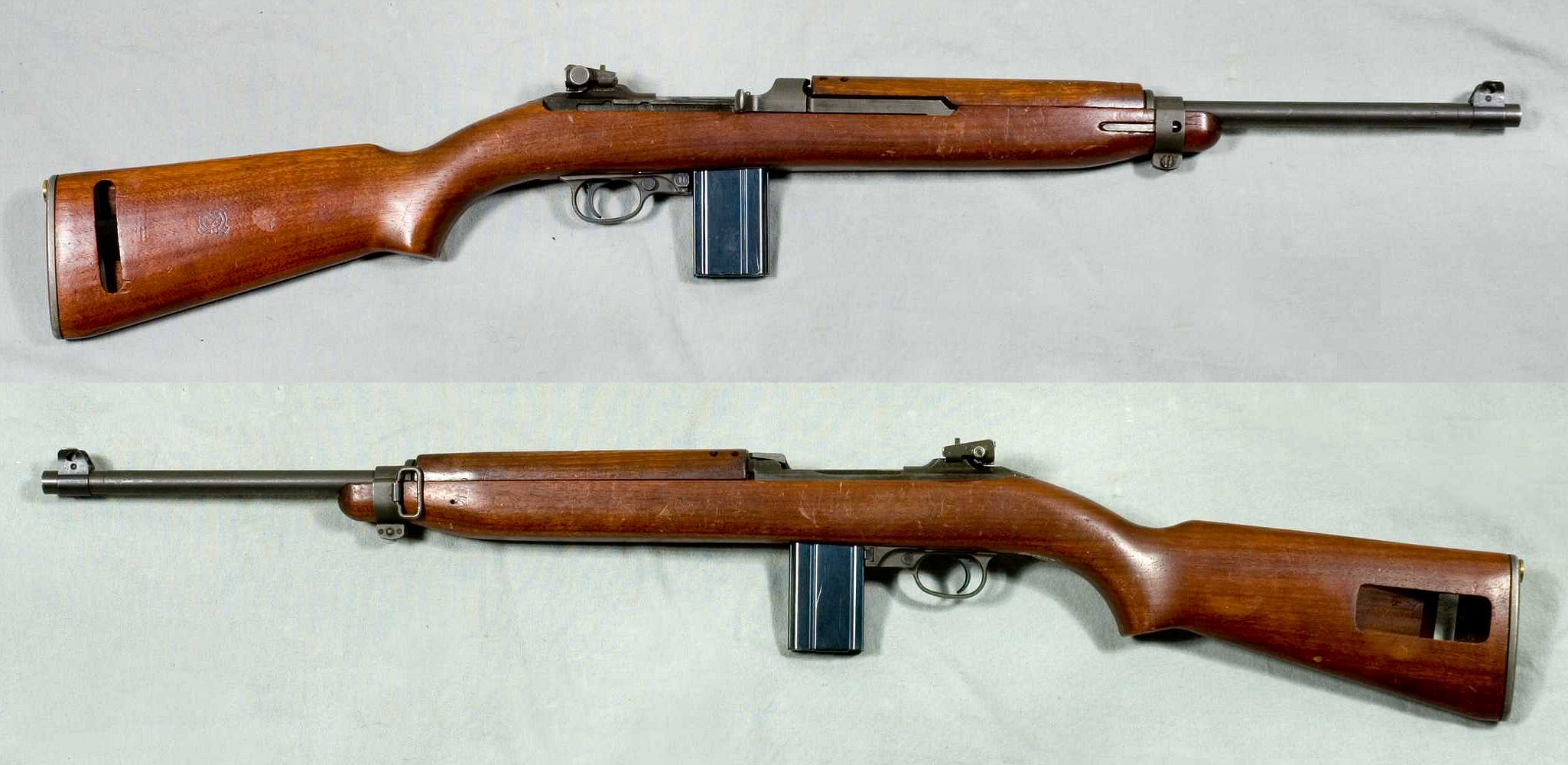
As reliable and useful as the M1 Garand and The Thompson Submachine Gun were, they each had one serious drawback. They were extremely difficult for support soldiers to use. The Garand was long and difficult to access quickly if surprised. The Thompson was a little easier to get at, but it was still heavy for its compact size. For the ammunition bearers, mortar teams, artillery crews, and other frontline troops, neither were very effective in keeping them safe when they were directly attacked. In need of a weapon that was easily stowed and easily accessed for these soldiers, the U.S. Army settled on the M1 Carbine. It wasn’t the most powerful firearm in the war, but it was light, small, accurate, and, in the right hands, just as deadly as a more powerful weapon. U.S. Paratroopers also appreciated the M1 Carbine for its ease of use, and frequently jumped into combat armed with the folding stock version. The U.S. government ending up producing six million M1 Carbines in the war, more than any other U.S. firearm. Variations of the M1 are still manufactured and in use today by militaries and civilians.
8. The MP40
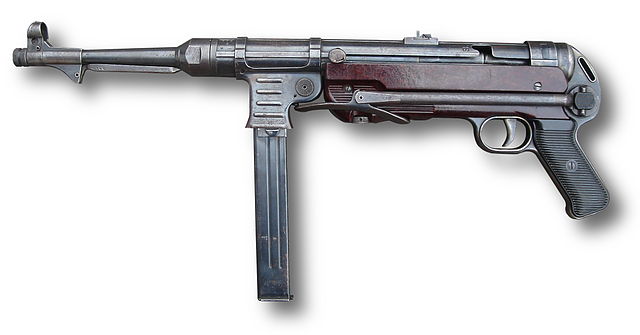
Although it was never issued in large numbers to infantrymen, The German MP40 has become a ubiquitous symbol of the German World War 2 solider and Nazis in general. It seems like every German in every war movie has one, but the MP40 was actually never standard issue for the common foot soldier. Usually used by paratroopers, squad leaders, and commandos, the MP40 saw service all over the war. It was especially useful in the Eastern Front against the Russians where the accuracy and power of long rifles was mostly wasted in the block by block street fighting. In fact, submachine guns like the MP40 were so effective that they made German planners rethink their reliance on bolt action or semi-automatic weapons, leading to the development of the first assault rifles. Still, the MP40 was one of the great submachine guns of the war, and became a symbol for the ruthless efficiency of the German soldier.
7. The Grenade

Not all the great weapons in WWII were rifles or pistols. Infantrymen also relied heavily on their grenades. Powerful, light, and the perfect size for throwing, grenades were an invaluable tool for assaulting positions. Just pull the pin, chuck it in, and suddenly storming a machine gun nest or bunker was a lot easier. From the iconic American “pineapple” grenade to the German stick grenade (nicknamed the “potato masher” due to its long handle), each nation relied on theses small, but deadly explosives to clear positions and generally scare the hell out the enemy. A rifle can do a lot of damage to human tissue, but the wounds caused by a fragmentation grenade are something else all together. Grenades were a very brutal weapon used in a very, very brutal conflict.
6. The Sten Gun

After the disastrous defeat and withdrawal from Dunkirk in 1940, the British army was facing a severe shortage of military equipment. Forced to leave most of their equipment on the beaches as they fled, the British armed forces took the opportunity to upgrade their standard issue weapons. They tried to use Thompson Submachine guns, but demand in the U.S. limited the supply. The answer was to come up with a British submachine gun. That was the Sten gun. Several models saw action in the war, but they all shared a unique side mounted magazine and slim profile.
It wasn’t a perfect weapon and could be temperamental, but at close range it was capable of incredible destruction. It was also very easy to assemble and disassemble, making it a perfect weapon for resistance forces and commandos. Resistance fighters in Poland and across Occupied Europe relied on air-dropped Stens to hassle and disrupt the Germans far behind enemy lines. The Sten gun worked so well as an insurgency weapon that it remained in use by paramilitary and guerrilla forces as late as 1994.
5. The Luger PO8
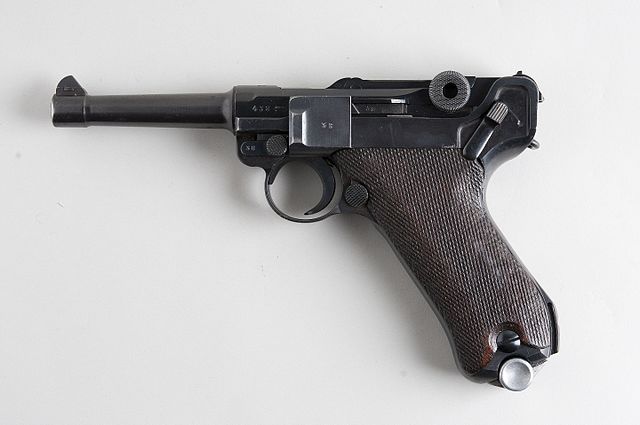
Every Allied soldier was on the lookout for souvenirs during the war and none was more prized than the German sidearm Luger P08. It may seem a little strange to describe a lethal weapon as “beautiful,” but the Luger P08 was truly a work of art and remains among weapon collectors the most sought after World War 2 firearm. Sleekly designed, built to incredibly high standards, and extremely accurate for a pistol, the Luger P08 was the ultimate symbol of the Nazi’s image of themselves: powerful, precise, and absolutely deadly.
Designed as an automatic sidearm replacement for the revolver, the Luger was highly prized for its unique design and long service life. Even though Germany was in the process of phasing the Luger P08 out before the war even started, it remains today the most collectable German weapon of the war. Many of the thousands that returned in G.I.’s loot bags are still in circulation today.
4. The KA-BAR Combat Knife

It’s an old military maxim that each army starts a war perfectly equipped for the last one they fought. For American soldiers, nowhere was this truer than in their service knives. The long trench knives they had, which were perfectly suited for the bloody trench battles of World War 1, weren’t going to cut it in the vastly different conditions of WWII. Enter the KA-BAR. Named after part of a barely literate trapper’s testimonial (it’s believed he was trying to write “kill a bear”), the KA-BAR quickly became much loved by every branch of the service that used it.
Besides its combat uses, it was perfect for just about everything a soldier might need a knife for out in the bush. It could dig holes, open cans, and cut through brush. The KA-BAR was originally designed for hunters and outdoorsmen, and that’s basically what a soldier is. The Marines, who spent much of the war fighting the Japanese in jungles, especially loved it. The KA-BAR is still in use today by the Marines, Army, and Navy, and is arguably the single greatest combat knife ever invented.
3. The Thompson Submachine Gun

The Second World War was the first widespread conflict where the submachine came into its own as a combat weapon. There are several on this list, but none are more iconic than the Thompson submachine gun. After first achieving notoriety in the Irish Civil War and in the hands of Prohibition gangsters and law enforcement, the Thompson was adopted by the U.S. Army just before the start of the war. Despite its weight (at over 10 lbs it was heftier than most submachine guns), it was a very popular weapon for scouts, non-commissioned officers, commandos, and paratroopers, who all valued its stopping power and rate of fire.
The weapon’s use was discontinued after the war, but Thompsons continued to pop up all over the world in the hands of armies and paramilitaries. It even saw action in the Bosnian War. For the soldiers who carried it in World War 2, it was an invaluable tool to keep them alive as they walked, ran, and fought their way across Europe and Asia.
2. The PPSh-41
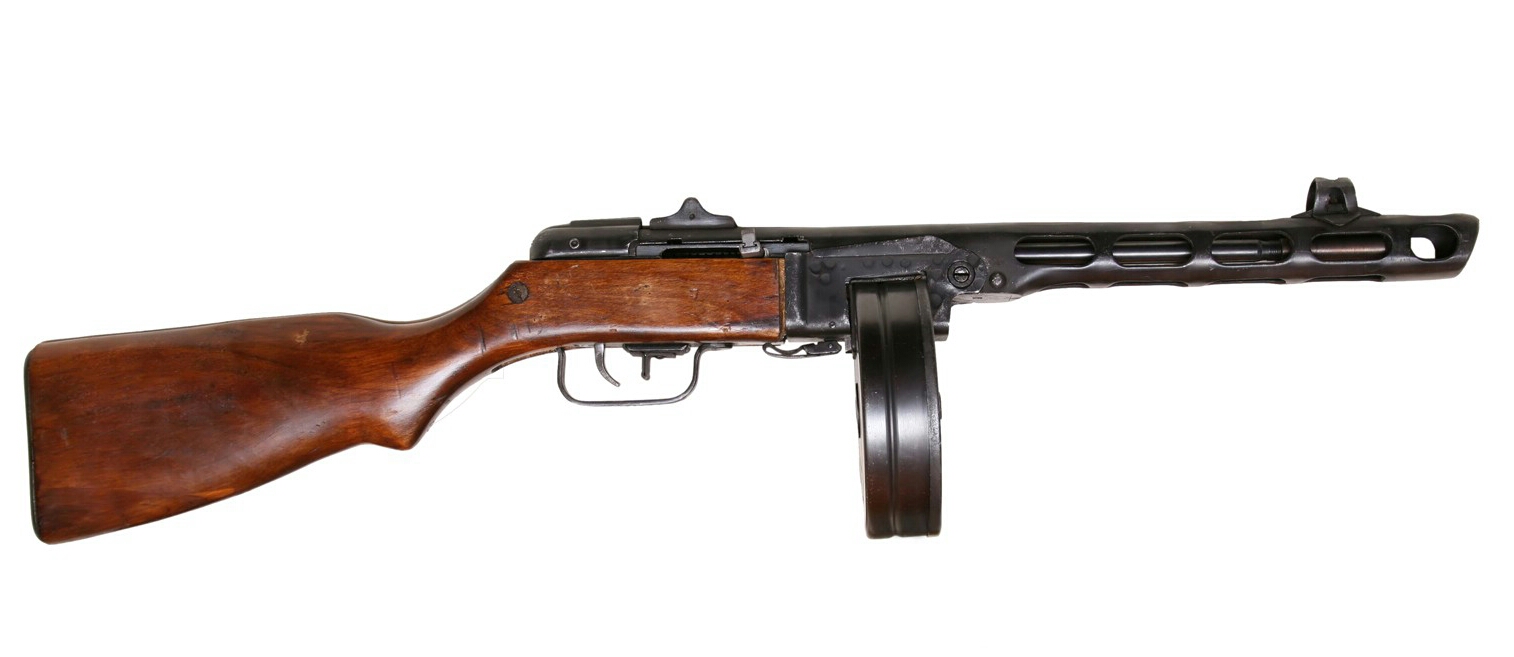
Despite the vastness of their country, most of the engagements that the Russian forces were involved in in World War 2 were close quarters affairs. From the Winter War with Finland to the defence of Stalingrad, Soviet troops were much more likely to meet their enemies at closer ranges than those their Mosin-Nagent bolt action rifles were designed for. The Russians needed high rates of fire at short distances, not accuracy or power. Enter the PPSh-41. A wonder of mass production, the PPSh-41 was simple to manufacture (at the height of the war Russian factories were producing 3000 a day), and simple to use.
It could be fitted with a drum magazine holding 71 rounds, and gave the Russians fire superiority at the close ranges they were fighting. The PPSh-41 was so effective that the Russian army outfitted entire regiments and divisions with it, something that had never been done before. But perhaps the best indication of the quality of the weapon was how valued it was among German troops. If your enemy can’t wait to get his hands on your weapons, you must be doing something right.
1. The M1 Garand
At the beginning of the war, nearly every infantryman in every major army was armed with a bolt action rifle. They were accurate and reliable, but they required that after every shot the soldier manually remove the spent shell casing and reload the weapon by manipulating a bolt. This was fine for sniping and other long distance engagements, but significantly limited each individual’s rate of fire. Wanting to increase their soldier’s ability to fire as many bullets at the enemy as possible, the U.S. Army brought into service one of the most famous rifles of all the time, the M1 Garand. Patton called it “the greatest battle implement ever devised,” and it often lived up to that high praise.
It was easy to use and care for, quick to reload, and gave U.S. forces rate of fire superiority over every force they faced. The M1 became a stalwart of the U.S. military and was in active service until 1963. Even today, several forces around the world use it as a ceremonial weapon for drills and it is prized as a hunting weapon among civilians. But for the men who took on the Germans, Italians, and Japanese, it was often the difference between life and death.
98 Comments
i liked the KA-BAR Combat Knife
what is your fav gun type
hi
Quite bad list, sorry. No mosin nor suomi-kp
Because it’s a piece of fire wood.
Lol the sten in the picture isn’t even the sten gun it’s a sterling sub machine gun
I need close combat weapons for a research paper ASAP
Whats with the Stg.44? it probably was the best weapon of ww2
Probably.
Mosin Nagant?
Crap
The pic under the Sten entry is a Sterling SMG…similar but a different weapon altogether…
Wow, There’s No Mosin?? This is a joke
Bad weapon
That’s not a Sten gun pictured… It’s a Sterling …formally adopted by the British army in 1951
Picture shows a Sterling SMG not a Sten.
“The Stg44 or even the FG42 beats the M1 as “the best WW2 infantry weapon” by miles”
Um, no. excellent weapons, but the Stg44 wasn’t produced in the numbers needed to make it a Top 10 and the FG42, while awesome, didn’t have the range or stopping power” of the M1 which could send a bullet long range through 3 or 4 lined-up Japanese.
The Fg-42 fired the full round 7.92 X 57 so yes it did. Half a million stg-44’s were made, so I would think that would be enough numbers, and that rifle was the death knell for the M1 Garand too.
Why am I not surprised that the M1 is rated as #1 in a “totally not biased” american ranking.
The Stg44 or even the FG42 beats the M1 as “the best WW2 infantry weapon” by miles.
this is so much fuga
The ten best WWII weapons – try the SPITFIRE !!
The Hurricane
Without both the battle of Britain would have been lost.
Try the doodlebug – the V1.
Try the U Boats that almost starved Britain to death !
Try the Tiger tank.
The Jerries had all the best kit (but we had spitfires and English roses to protect).
Thanks to the yanks (you turned up eventually) and thanks to the Commonwealth and Russians really, it’s all academic and we can argue about it for fun (in English not German).
But those few guns plus a grenade and a knife are not the best ten weapon of WWII.
If I had to choose ONE – it would be the U Boat.
Shocking to the moral, properly costly to the allies, hard to defeat and extremely effective. The U Boats did a lot more damage to the allied cause than bombing.
Where is the Owen gun? It was at least as reliable as the PPsh, and as cheap to make as the sten gun.
Exactly. Where is the owen gun. Better then the thomson, sten, mp40 etc on trials and the troops loved it. Only politics got in the way of the US mass producing it for there troops as it beat the thomson hands down.
German MG 42, and US M2 .50 cal.
actually 7,62×25 mm bullet that ppsh used was (and is) very very fast and slices thru people like cheese. my fathers colleague put one thru the skull of a terrorist shqiptar at the distance of about 55mm, bullet went right thru and traveled for more than 100meters until it was found in the wall.
therefore that calibre is pretty strong. it has no immediate stopping power but other than that? great military bullet.
No FG42(Fallschirmjager gewehr 42)
..
It’s not a good list.
That’s a Sterling and not a Sten.
The omission of Lee-Enfield demonstrates the author knows nothing on the subject, and I suspect his information started with Call Of Duty and stopped with Wikipedia.
TOP 5 best rifles ;
1- STG-44
1bis- M1 carbine
2- M1 garand
3- SVT-40
4- K43
5- LeeEnfield N°4
No contest possible. M1 garand has the edge over the 2 other semi autos, because of its ruggeness and reliability. However, K43 and SVT-40 are great rifles.
The LeeEnfield N°4 is the quintessence of the family, ultra robust, 10 rounds, ultra quick and smooth action, exellent peep sight. Kar 98K doesn’t have those features, but is a good rifle.
The STG-44 is a clear winner, no contest possible. First true assault rifle, massively used in the last year of the war.
The M1 carbine should be in the list, but it’s a too tiny and not robust enough weapon, with too small power. Not a true battle rifle, but a very good weapon close range, and urban area, much better than any bolt action rifle. If they had used the 30 round magazine early on, i’d put it on par with the STG-44, but rather between M1 rifle and STG44.
Other great rifles :
6- US17 Enfield
6bis- Pattern14 enfield
7- leeEnfield SMLE N°1 mkIII
8- M1903A3 springfield
9- Karabiner 98K
10- Mosin nagant M39 (finland)
11- russian mosin nagants (M91/30, M38, M44)
12- Arisaka 99
US17-P14 : extremly good rifle, second only to the N°4 enfield because of the 6-5 rounds, weight, and action less smooth. US17 over P14 because of the exellent 30-06 cartridge and 6 round mag.
SMLE : classic of the whole british empire, prime rifle of british army worldwide, even if the N°4 started to remplace it from 1942.
M1903a3 : best model of the Springfield, simple and effective rear sight. Other models sights sucks too much for a battle rifle.
Kar 98K : classic, robust, effective. Mauser 98 action, really hard to beat.
M39 : by far the best mosin nagant ever, improve every aspect possible over the 91/30. It is classed under mauser/enfield actions, but in very cold climate, this rifle outdoes them all. Mosin M39, best rifle for under -15°C.
M91/30 : crude, but accurate, cheap, and extremly sturdy rugged, reliable. A tremendous rifle if you can master it, and just like the M39, prefer this in cold climate.
M38/44 carbine : just like the 91/30, but for non combatants. Good but lacks range and has painful recoil.
Arisaka 99 : Second japanese main rifle, shorter and in a powerful caliber compared to the 38. Good extrapolation of the mauser 98 action, but nothing tremendous (especially the poor sights).
WHAT A JOKE ! HAHAHAHA…
L2 sterling as a sten ? REALLY ?
No STG-44 ? REALLY? it’s by far the best weapon of the war.
No Lee enfield mentioned ? REALLY ? by far the best manual action rifle of the war, and of any war, period. Be it the SMLE N°1 MKIII or the even better N°4…
P08 the only handgun mentionned ? REALLY ? HAHAHA Best handguns of the war : P38 and browning 35, seconded by the M1911A1 and TT33, also the polish VIS radom.
This list is just your opinion. M1 Carbine is weaker and less effective than StG44 yet it’s not in the list. Luger P08 wasnt used much by the Germans as Luger bearers were officers, who were supplied with MP40. The Sten was a worse weapon than BAR, Bren and FG42 yet it gets a place in the list. M1 was mechanically unreliable in muddy and sandy conditions(you’ll know that if you read the veteran’s complaints of it. Kar98k was a better weapon than the M1 Carbine due to its superior accuracy, firepower(M1 Carbine uses a weak round to reduce the impact against his user) and reliability. That said, if M1 Carbine, Sten and Luger gets a place in the list, why not StG44, FG42 or Gewehr 43? As the title said, we do not talk about its service length but its service life. Why is KA-BAR even in the list? I know it was responsible for many kills by paratroopers and troops involved in certain missions but it never did anything like the Sten or MP40.
No.6 is a Sterling not a Sten.
And why no Lee-Enfield? The best bolt action rifle ever.
The article looks to have been written by an American teen whose experience is limited to Hollywood movies & video games.
In trying to provide some alternative argument, I’ll happily say that I think the Garand needed to be on the list, but the top of it? Also in the end the Australians dropped the sometimes unreliable Sten and the heavy Thompson for the Owen submachine gun. I won’t say it was better than either of them but it was definitely a preferred choice. Also if you want to cover all bases – how famous a gun has become or how much of an impact it had on the soldiers of ww2 – you had to consider the MG42 or even the earlier used MG34 for their unbelievable rate of fire, widespread familiarity among Allied troops on all fronts and the sheer psychological terror of hearing one rip the countryside apart.
No MG42 ? One of the best, no the best Machine Gun of the War
Ever heard of an old marine corps saying..
“accuracy over rate of fire”
American weapons fanboys..
I know most of you have never heard of this, but Suomi kp, in english Finland sub machine gun. It was better version of the russian ppsh41. And actually made before it. Russians thought it kicked **s and decided to make a worse and cheaper version of it. Seriously, if a list has ppsh41, it should have Suomi kp….
What about the owen gun. Made in Australia and beat the other submachine guns at trials. Due to politics it wasnt mass produced till later and the Americans which loved it couldnt get approval to produce it and supply to there troops. Was used up to the vietnam war by Australian troops as jungle or desert was no bother to it. Wonder how it would have fared in snow.
However i agree the Suomi should be above the ppsh41.
Why do Americans always think that everything of theirs is the best? The Lee Enfield .303 was used by thousands of commonwealth troops who would testify it to be the best weapon of the war, bar none.
We don’t think that, I certainly don’t think that. Our gun control laws are horrible for one. But I think that the rest of the world likes to think we think like that. But none of my family and friends think this way.
I’d like to point out that you have a photo of a Sterling not a Sten. One has a curved magazine the other a straight magazine. I’d link to wiki but the site won’t let me.
Same mistake I saw. The Sten barrel also wasn’t encased in a perforated heat shield like the Sterling in the picture.
These lists always end up comparing weapons meant for different purposes but the idea that the lovely M1 Carbine should be rated ahead of so many other serious weapons is slightly absurd.
If you broke it down into categories it would make more sense. So; best Sub machine gun.
Well presumably it was the Suomi followed by the Beretta Model 1938.
Best battle rifle: Has to be the Garand. Yes the 303 had a bigger capacity (thanks to the .276 Pedersen cartridge being ruled out (th at would have made the garand a ten shot weapon) The German MP42 wasn’t regarded as the solution the Germans had hoped for so we can rule that one out. The Russian semi auto wasn’t as reliable so on merit and the ability to go bang bang bang gold medal to the US.
Best light machinegun.
Has to be the Bren. FN made a quick change model of the BAR but the US ignored them.
Unless you argue that the weight of the MG 42 was sod all more than the Bren in which case I would concede and agree the MG 42 was the best light and General Purpose Machine gun of WW2.
Pistols.
Browning HiPower
Just my thoughts
you say that like a BAR wasnt as heavy as an mg42
mg42: 25.51 lbs
BAR(M1918): 24 lbs
Who compiled this list and what is it based on? Number of units produced? Number of casualties inflicted? If so how in the world did they end up with 4/10 being American? Another example of failed US public education.
Agree! The British Enfield rifle, the 1911 .45 pistol, the BAR, and a host of others should be considered.
You say this is a failure in US education, but you fail to realize the ignorance of your own statement. No one said what this list was based off of. Besides, what would numbers produced mean in terms of quality? German and American had the best weapons of the era, respectively. Both the Germans and Americans produced weapons from which many of today’s modern weapons are based off of. What lasting weapon design from WW2 have the Russians, British, French, Italians, or Japanese produced? On the other hand, the M1911 has spawned more pistols based off of its design than any other handgun. The STG44 was the first assault rifle (and probably deserved a place very high on this list).
the russians made the 91/30 mosin nagant, produced in mass numbers, and used my millions today, also the russian sks rifle first produced in 1943
Well, they won the war all by they selfs didn’t they…. 😉
The soviet union did
Has anyone heard of a pencil pistol from WWII German used for suicide if caught by the enemy?
Browning’s 1911 .45 ACP pistol served in both the Great War and WWII; a glaring ommision IMHO.
All the top most gun were looking nice. Especially i have seen the Thompson sub machine gun in lots of films.
no IEDS
“The Top 10 Most Recognizable WW2 Weapons Featured in Movies I’ve Seen” might be a better title for this article.
These weapons feature prominently in recent movies like Saving Private Ryan and that aweful movie by Tarantino.
Sten 9mm was often tossed away by experienced troops – it has a notoriously unreliable safety.
World War 2 Infantry weapons that changed warfare.
– Sturmgewehr MP44 considered to be the first assault rifle and inspired the highly popular AK 47.
– MG 42 Machine gun had both light and heavy versions, extremely high rate of fire and excellent range, veterans who were shot at by these described the sound as someone tearing paper, but really loudly.
– 80mm mortar, light, highly portable artillery.
– Antitank weapons like Panzershrek or Panzerfaust -for days teenage boys held off veteran Russian tanks crews with these before the fall of Nazi Germany.
And the glorious 88mm FLAK…..this list sucks xD
I don’t know if I would say they AK47 was inspired but almost ripped off from the stg44, beautiful assult rifle still to this day one of the greats.
mg42 i’ve head paper being ripped or a pair of jean being ripped “Hitler’s Saw”. crazy rate of fire compared to a bren and browning. 1. 2. 3 max second burst. any more than that if it had wings it would fly.
lee enfiled No.4 is a beauty too.
I think the brits were planing on assinating Hitler w a K98 at the eagles nest…
the simonouv project (“ak”) was started before the war, but this could also be for the germans coming in and destroying hundreds of thousands of svt-40s and taking the design and copying it to come up with the gewher 43
And that ppsh was not used in winter war against finland in 39. Soviets got inspiration to ppsh from finnish suomi-kp (KP/-31). And first ppsh’s enterd service in 41 …
The Colt M1911 Semi-Automatic pistol belongs on this list. How many MOH winners used this weapon in their medal winning action?
Well Said!
The Medal of Honor is not a prize to “win”, it is earned and awarded to the recipient. I dont mean to beat you up about this, but it is something that really irks me when I hear/see it being disrespected (almost always unintentionally) and reduced to something akin to a carnival prize. Buy i agree with your point: the M1911 is cited or referenced in more Medal of Honor award citations than any weapon before or after its adoption.
Probably only because they run out of ammo in their other crappy sidearm…
KA-BAR = Knife Attachment – Browning Automatic Rifle. Let’s put the “killed a bear” rumor to rest.
I quote: “How KA-BAR Got Its Name
Our name dates back to the early 1900’s from a fur trapper testimonial. He wrote that while trapping, his gun jammed leaving him with only his knife to kill a wounded bear that was attacking him. He thanked us for making the quality knife that helped him to kill a bear, but all that was legible was “K a bar”. Honored by the testimonial, the company adopted the phrase KA-BAR as their trademark. ” (taken from KA-BAR’s website.) The fact that the M1 Garand has no means of attaching a knife, (aka bayonet), further serves as truth to the trapper’s origin of the knives’ namesake.
correction: While I named the M1 Garand in the previous post, what was meant was the Browning Automatic Rifle (BAR). The body of text and facts wherein contained remain the same, save for the naming of the M1 garand. Thank you.
Umm I know I am late here, but oh well. Tell me, what is the lug under the barrel of the garand, just ahead of the staking swivel isn’t that the BAYONETTE LUG??? I have owned 5 and trained with one in high school, and yeah, they sure do accept a bayonet, the KA-Bar is a knife NOT a bayonette
the kill a bear myth is just a myth its the ka means knife attachment and the
bar stands for the browning automatic rifle
the BAR was not made to have a bayonett
Great list
Although I am suprised the Sturmgewher 44 was not included even though it was mentioned twice in the list.
yeah i agree, stg44 was technicly the first modern assualt rifle and obviously thats what our armys use today, how could they even consider a 8 round semi automatic weapon to be better than a 30 round full auto/semi auto rifle that could atleast detach its magazine for ease of use
stg44 was a revolution.
I’m supprised that he mp44 wasn’t mentioned for its industrial “stamping out” reproduction.
Ican’t believe it either… Even the Military Channel ranks the MG42 as the best ever… They called it Hitler’s buzzsaw. Why do you think we lost all those brave men who fought against all odds and 2700 rounds a minute. The Stg 44 also revolutionized the game for the aforementioned reasons. Why do you think we imported all the German Scientists and Engineers?
Different weapons with different purposes. Each should have been ahead of the M1 Garand…. But to our (USA) Credit… The M1 Garand and the Thompson won the war for the good guys. So I respect the M1 as the best gun, but there were two others that revolutionized the game… and yes they came from Nazi Germany.
I think you graded this “m1 ” as the best just because you love your country very much.
Otherwise, if u can b neutral, The no. 1 would definitely have been the MG 42 / STG 44
He might love his country very much but the MG 42 and the STG44(MP44) are Machine Guns and Assault Rifles respectively. Although, you’re correct they are superior weapons, the author did not rate any MGs and ARs on hence why they’re not included.
Also, please feel free to show any widely issued semi-automatic rifles for any army aside from the M-1 Carbine/Garand’s. The fact that it was the US Army that brought semi-auto rifles to the battlefield while the rest of the world had bolt action is remarkable.
Notice there are no crew served weapons on the list, hence the exclusion of the machine gun. The STG44, though revolutionary was made in relatively small numbers (420 thousand) and thus was not even as common as the mp40 (over 1 million). If you judge it by its post war impact, its in a class of its own, but it did very little to change the course of the war.
U mean mp 40
the stg44 is just a copy of the mp44
the germans started to make a weapon called the wonderwaffa.
this isnt call of duty dude
this isnt call of duty oh my god people are so stupid nowadays
while wonder weapons were things *gewehr43 and the real der reise there never was a wonderwaffe
but i do love zombies
The StG44 was the MP44, the MP44 was to keep it off Hitler’s “radar” until he embraced the weapon and named it the StG44, the same weapon.
No. StG44 IS MP44. MP is just english short for machine pistol – exactly what StG short is in german.
Assault Rifle term didn’t even exist when this weapon was created.
Wrong.
MP in English is the same in German: MP -Machinen Pistol
StG meant SturmGewehr which translates as Assault Rifle.
And yes, good old uncle Adolf himself gave us this wonderful name…
the term stg44 was used with the first production by mauser, whereas the mp44 was the same construction but built by walther.
just how a m14 is the same as an m1a, but the M1a is built by springfield armory
exactly and to expand this this it was because he didn’t want an assault rifle when first suggested so it was originally the mp44 as that name would suggest its an smh
How is it a copy of MP 40 they are two different types of weapon learn your history
Rofl u r getting wrong, srsly wrong STG is short for sturmgewehr which means storm rifle basically and mp44 is just a cover up name coz Hitler didn’t like assault rifles but then Hitler changed his mind about it and insisted on calling it sturmgewehr aka assault rifle the term was created at that time already
Because you cannot make any article that somehow “glorify’s” the accomplishments of NAZI germany in today’s politically correct society.
Yes, I too was surprised not to see the Stg 44
However, the sturmgewehr wasn’t particularly innotive, it wasn’t the first and by a long shot, and its ammo was weaker and not any lighter. I’m not saying it’s bad, it’s just not my pick.
That Sten is a Stirling.
I thought that when I saw it too, the vented front gave it away.
I was under the impression that STEN stood for STerling ENfield as did BREN stood for BRno ENfield. Am I wrong?
You are right pal, btw, Enfield developed the Lee Enfield bolt action rifle, to countermeasure the german Mauser K98.
Close, but not quite. STEN stands for Shepherd, Turpin, and ENfield, after the chief designers, Major Reginald Shepherd, Harold Turpin, and Enfield
Im sorry, where is Sturmgewehr 44?
First of all, it wasn’t the first and by a long shot. Also, the ammunition was weaker, and not any lighter. It wasn’t particularly innotive.