

The French Revolution is regarded as being instrumental in the foundation of modern democracies and ideologies. By far, the most iconic symbol of this revolution is the gruesome guillotine. Now that the French have gotten rid of their kings and queens for good, the guillotines have been put away in museums. Hopefully, they’ll never have to take them out ever again.
So without further ado, here are ten facts about this killing machine.
10. Robespierre’s Execution
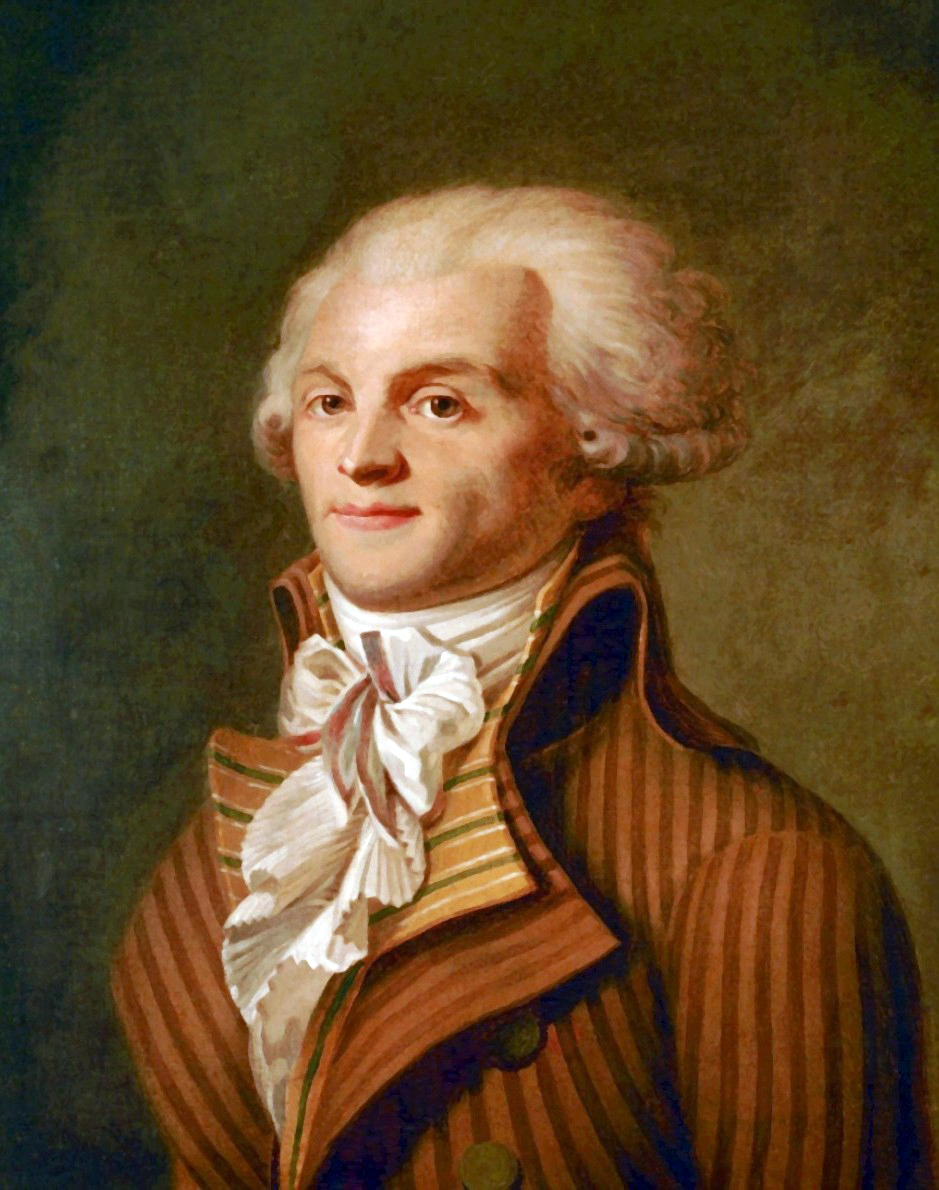
The “Reign of Terror” was led by Maximilien Robespierre. He led the Department for Public Safety that was supposed to get rid of the enemies of France and those who were losing them the war. In time, he became corrupted with power, and realized that he could use his position to get rid of anyone that he didn’t like. No one was safe.
Robespierre had turned into a dictator, just like the King that he had executed. With the new government fearing for the worst, Robespierre and his followers were arrested and sentenced to death. Robespierre didn’t like the idea of going to the guillotine, so he tried to shoot himself in the head. Unfortunately for him, he missed and only managed to smash his jaw. Within a week, he was taken to the guillotine with a bandaged jaw.
What follows is Robespierre’s execution as described by an eyewitness. and quoted in Rayner and Stapley’s History at Source: The French Revolution 1789-99:
“At four o’clock in the afternoon the sinister procession came to the courtyard of the Palace of Justice. No crowd of this size has ever been seen in Paris before. Most of the watchers fixed their eyes on the cart that Robespierre was riding. The miserable creature was all mutilated and covered with blood. Robespierre kept his eyes shut and didn’t even open them again till he was being carried up to the scaffold. The wretched man’s head was now no more than an object of horror and disgust. When at last it was separated from his body, and the executioner took it by the hair to show it to the people, it presented an indescribably horrible sight.”
9. Down With The Maximum!
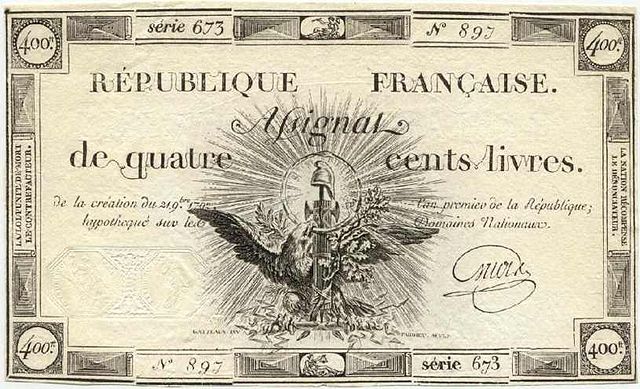
The Revolution brought about many changes, and one of these were “The Laws of Maximum.” These laws stated that the new government had control on the prices of bread and other essential foods. In addition to this, these laws stated that workers could only be paid so much, i.e. a maximum. This law was terribly unpopular with the mob, who went to the executions. So, as they watched heads roll off the guillotine’s platform, they didn’t shout “Off with his head!” or something else of the sort. Instead, the mob shouted “À bas le maximum!” (“Down with the maximum!”)
8. Complimentary Transport
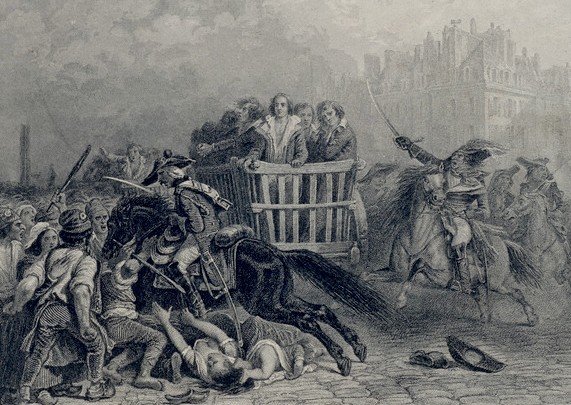
Victims weren’t expected to walk to the guillotine. You see, being sentenced to have your head chopped off also included complimentary transport to your death. Victims were carried along in a small cart known as a “tumbrel.” (This is also sometimes spelled as “tumbril”) Tumbrels were initially designed to be drawn by a single animal with the intention of transporting animal manure. However, once the Revolution began, these small wooden carts started being used to transport victims to the guillotine’s platform. Sometimes the tumbrel would be painted red (as in George Danton’s execution), but usually these carts were left unpainted (as in Marie Antoinette’s.)
7. Marie Antoinette’s Execution
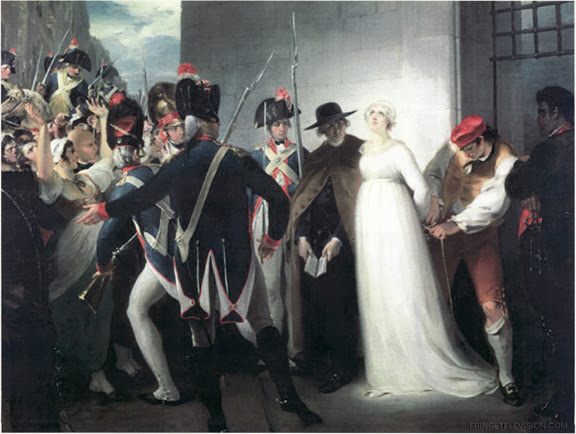
On October 16, 1793, Marie Antoinette was given a joke trial — everyone knew that she would have to be killed. Although the Queen went to her death quite bravely, her journey to the guillotine wasn’t quite pleasant. Guards tied her hands, chopped her hair so it wouldn’t get in the way of the guillotine, and then chucked her in a tumbrel to be lead through the streets of Paris. As she stepped on the platform, she trod on the executioner’s foot and the man cried out in pain. The Queen’s famous last words were, “Pardon me sir. I did not mean to do it.”
As the guillotine was prepared for her death, the executioner removed her white cap that covered her head. Turns out that the reckless haircut that the guards had given her had left her almost bald. The mob simply laughed and jeered at her. Once the blade fell, a revolutionary picked up her head and waved it at the cheering crowd.
6. Louis XVI’s Execution
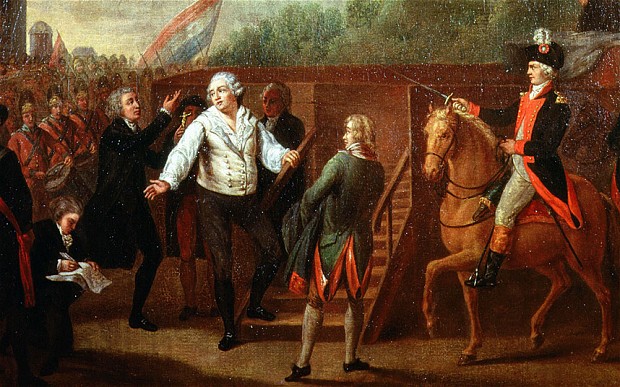
The King at the time, Louis XVI was executed on January 21, 1793. For a machine that was supposed to provide a painless and quick death, the King died horribly. As the blade fell down, he screamed (well, wouldn’t you?) The problem was that his neck was so fat that the guillotine failed to slice his head off the first time. However, it did manage to come off after a second attempt. A young guard picked up the King’s bloody head for the crowd to see. As the mob rushed to dip handkerchiefs in the blood, they cried out, “Long live the Revolution!”
5. Bloodbaths Outside Of Paris
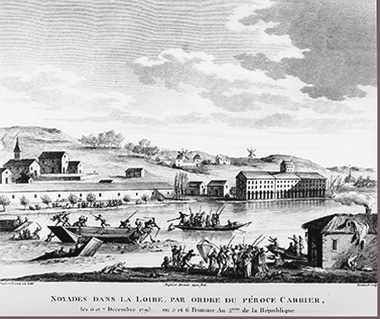
Sadly, the bloodshed wasn’t limited to just Paris. The city of Lyon was the second largest city in France before the Revolution. It owed its success to the silk industry, and as a result of the Revolution, the city found itself in financial crisis. Because of this, Lyon rose up against the Revolution since many people didn’t want to support a movement that had destroyed their business and trades. What was the consequence to all of this? Well, Lyon ended up suffering mass guillotine sessions, since there were so many against the Revolution. The guillotine couldn’t get through enough necks quickly enough, so the Revolutionaries brought in firing squads to help kill more people.
Meanwhile in the city of Nantes, the guillotine was also too slow. Here, the Revolutionaries filled up barges with condemned people, towed them into the middle of the river Loire and sank them. Also, guillotines in Nantes were painted red so the blood wouldn’t show.
4. It Was Too Efficient

Prototypes of the guillotine were first tested on live sheep and calves, while its first human test subjects were corpses from a local hospital at Bicêtre. The first live victim to be executed by Guillotin’s machine was a highwayman called Nicolas-Jacques Pelletier. On the 25th of April, 1792, crowds turned out to watch his execution. However, the crowd ended up being a bit disappointed and went away grumbling, since it was too anticlimactic to satisfy the bloodlust of the crowd. A skilled executioner could execute a frightening two people a minute, which was too efficient and quick for the public’s “viewing entertainment,” and they quickly called for the return of the gallows.
3. Not Even Corpses Were Safe

According to Guillotin himself, he was a kind man for introducing the guillotine. He didn’t want criminals to suffer, and so he wanted a machine that would make the process of execution as painless as possible. He stated that all they’d feel was a tickle and a slight chill at the back of the neck (not one of the guillotine’s victims has ever argued.)
However, there was one victim who felt nothing at all. Named Charles Valaze, he stabbed himself to death in court in 1793. Because of the law that Guillotin had helped to pass, “Every person condemned to the death penalty shall have his head severed,” the judge ordered that Valaze’s corpse had to be guillotined anyway.
2. Marie Tussaud
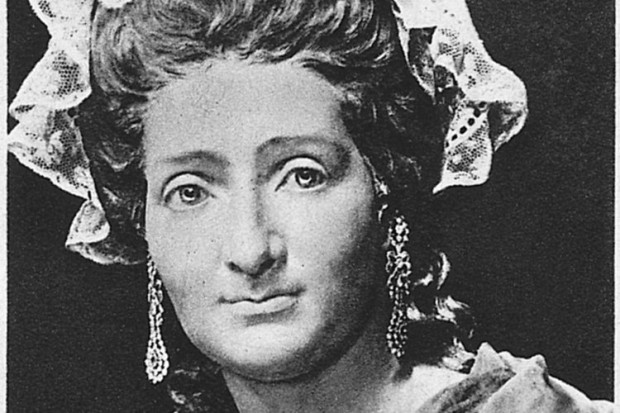
Most likely, you’ve heard of Marie Tussaud’s wax museum in London. But do you ever wonder how Tussaud got famous by making wax figures? Well actually, the not-so-well known truth is quite grim! French women were required to be taught about the Revolution, and they were also encouraged to take their knitting and crafts to the executions and watch. Being talented with waxworks, Tussaud decided to cash in on the Terror. She used to make “death masks” of famous heads that she picked fresh from the guillotine basket. Tussaud would carefully pour hot melted wax over the heads and then sell them for a living. Apparently, her collection of wax heads was so successful that she toured around Britain for over 30 years, before setting up her famous waxworks in London.
1. Be Careful What You Lobby For
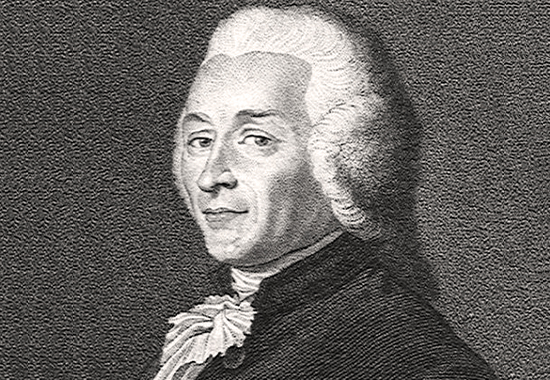
As you could probably guess by the surname, Dr. Joseph Ignace Guillotin was a French doctor who invented this efficient killing machine. Actually, that’s a lie. Guillotin never invented the notorious machine. Invented by Dr. Antoine Louis, it was initially known as the “Louisette” or “Louison” (criminals also referred to it as “The Widow”.)
The machine was introduced to France by Guillotin, who was only a lobbyist for it. However, because of Guillotin’s speech to end the public torture involved with capital punishment, his name became synonymous with the machine. After Guillotin’s death in 1814, his children unsuccessfully tried to disassociate the family name from the machine. Instead, they were allowed to change their name.
Guillotin’s name stuck to the machine like glue, making this the only method of execution ever named after someone. Think about it: lethal injection, firing squad, hanging, electric chair, burning at the stake, poisoning, lay-down-here-while-this-elephant-crushes-your-skull – none of these brutal execution methods are named after an individual. Mr. Guillotin must feel very special indeed.
1 Comment
Robespierre is pronounced Robe as in “I put a robe on over my pjs.” Not Rob as in “I am going to rob the store.” The pronunciation was so bad I couldnt listen.