

The first permanent photograph was produced in 1826 by French inventor Nicéphore Niépce. The picture is named View from the Window at Le Gras and it took over 8 hours to expose. The first photograph of a person was taken in 1838 by French chemist Louis Daguerre. The picture is named Boulevard du Temple and it shows a busy street in Paris. The exposure time on the image took over ten minutes, but a man that was sitting down and getting his boots polished is visible.
In the year 1776, the United States formally declared independence as one new nation, claiming their sovereignty and rejecting any allegiance to the British monarchy. The declaration resulted in an explosion of fighting in the American Revolutionary War, which had started the previous year, in 1775. The war pitted Great Britain against the U.S. colonies and their allies, including France, Spain, and the Dutch Republic.
Since the time of the Declaration of Independence and the invention of photography, hundreds of legendary pictures have been published, pictures that define an era in United States history and represent the struggles of a nation. This article will document important moments in U.S. history and describe ten lasting images. All of the photographs represent what America underwent in order to achieve the world status held today:
10. Little Round Top to Devil’s Den

This image is available from the United States Library of Congress‘s Prints and Photographs division
under the digital ID cwp.4a40067.
In 1846, the Mexican-American war began in the wake of the annexation of Texas. The conflict was the first war in history to be captured on camera. During the U.S. presidential election of 1860, the Republican Party, led by Abraham Lincoln, campaigned against the expansion of slavery. In response to Lincoln’s victory in the 1860 election, seven U.S. states declared their secession from the Union. On April 12, 1861, hostilities erupted when Confederate forces attacked a U.S. military installation at Fort Sumter in South Carolina. Lincoln responded by forming the Union Army. Fighting quickly spread and the U.S. Civil War was in full swing, with a total of 15 states seceding from the United States. By the end of the conflict, over 620,000 American soldiers were killed. The Union victory meant the end of the Confederate Army and it abolished slavery in the U.S. The war strengthened the role of the federal government and shaped the reconstruction era in the United States that lasted until 1877.
The Photograph
The American Civil War (1861–1865) was the fourth war in history to be captured on camera. It was the most extensively covered conflict of the 19th century and hundreds of photojournalists emerged during the war. Countless famous images have survived from this era in U.S. history. After the 1863 Confederate success at Chancellorsville in Virginia, Robert E. Lee led his soldiers through the Shenandoah Valley to begin his second invasion of the North, labeled the Gettysburg Campaign. By July 1, 1863, Lee had concentrated his forces near Gettysburg, Pennsylvania, with the objective of engaging the entire Union army and destroying it. The Battle of Gettysburg was fought from July 1–3, 1863. The decisive battle produced the largest number of casualties in the American Civil War. On the second day of the conflict, both armies had completely assembled. Robert E. Lee understood that he could greatly damage the Union forces if his troops could capture Little Round Top, which was a hill located on the far left side of the Union line.
Little Round Top was an extremely important hill in the military defense of the Union Army. For this reason, Robert E. Lee arranged and launched a heavy assault on the Union left flank. Union General K. Warren realized the importance of the area and dispatched Vincent’s brigade and the 140th New York to occupy and defend Little Round Top. The defense of Little Round Top with a bayonet charge by the 20th Maine is one of the most fabled episodes in the Civil War. The ground surrounding Little Round Top has witnessed unimaginable events and more bloodshed than any other place in the United States. One of the most famous areas is a patch of land known as Devil’s Den, which is a rocky expanse of shrubs and trees located directly west of Little Round Top, across the Plum Run Valley. Devil’s Den is peppered with an outcropping of massive boulders and rocks. These geological formations gave the Confederate Army problems when trying to conquer the hill. The image that I have selected shows a famous statue of Union General Gouverneur K. Warren looking down from Little Round Top to Devil’s Den. The picture documents the most deadly battlefield in United States history. The image was taken circa 1910 and is a bit blurry, but the steep angles and large rock formations can easily be made out.”
9. The First Transcontinental Railroad

After the end of the American Civil War, the United States went through a series of political changes. Government officials established laws on land ownership and focused on national expansion. In the 1840s, the U.S. media coined the phrase manifest destiny, which is the belief that the United States was pre-ordained by God to expand from the Atlantic coast to the Pacific coast. The government enacted this concept by establishing treaties with foreign nations and native peoples. Many forms of political compromise were enacted, as well as military conquest. In some cases, this expansion was accomplished regardless of social and legal consequences for Native Americans. On January 24, 1848, James Marshall discovered gold in the tailrace of a mill near present day Sacramento, California.
After preliminary digging, it was revealed that this area of California held enormous gold deposits. Word of the discovery quickly spread across the United States, even reaching experienced miners in South America and Europe, who quickly traveled to the area. Between the years 1848-1852, thousands of Forty-Niners embarked on California, increasing the state’s population from 14,000 people to 200,000. During this time in American history, in securing and managing the west, the U.S. federal government greatly expanded its powers, and by the end of the 19th century, the nation evolved from an agrarian society into an industrialized power. One of the largest steps in this expansion was the development of the First Transcontinental Railroad, which was completed in 1869.
The Photograph
By 1862, a number of rail lines had been constructed in the United States, extending as far westward as Omaha, Nebraska. In the west, railroad lines were pushing eastwards, starting in Sacramento, California. The U.S. government understood the need for a Transcontinental Railroad, so they developed a project to link the two tracks, forming one large railway line. The construction of the railroad required six main activities. The job was highly labor intensive and the workers averaged about two miles (3 km) of new track per day. The two separate work crews finally met at Promontory Point, Utah on May 10, 1869. To commemorate the event, Leland Stanford, one of the prime backers of the Central Pacific, hammered the final golden spike in triumph, linking the two lines. It was a major stepping point in the history of the United States and many photojournalists documented the event. The picture I have selected shows workers from the railroad crews meeting and celebrating the First Transcontinental Railroad. After the completion of the line, a cross-country trip in the U.S. was reduced from about four months to one week.
8. Dodge City Peace Commission
By the 1870s, a new code of behavior was becoming acceptable in the United States. People no longer had a duty to retreat when threatened. This was a departure from British common law that said you must have your back to the wall before you could protect yourself with deadly force. The code of the West dictated that a man did not have to back away from a fight. He could also pursue an adversary even if it resulted in death. At the same time, most justices of the peace were poorly schooled in law, politically corrupt, and depended on assessing fees and fines to make a living. It was an era characterized by disorganization in law and order. Some of the criminal activity was carried out by Mexican and Indian populations living along the U.S. border; however, infamous American outlaws also emerged, including Jesse James, Billy the Kid, the Dalton Gang, Black Bart, Butch Cassidy and the Wild Bunch. Some of the outlaws, such as Jesse James, were products of the violence of the Civil War.
The Photograph
Wyatt Earp was an American peace officer who worked in various Western frontier towns during the late 1800s. He is most well known for his participation in the 1881 Gunfight at the O.K. Corral, which took place in Tombstone, Arizona Territory. The immediate cause of the gunfight was the arrest of a group of cowboys by deputy federal marshal Virgil Earp. The following day, family and friends of the cowboys entered Tombstone. However, the men would not turn over their weapons, which was the town’s law. Tensions quickly elevated and three of the men were shot dead by Wyatt Earp, Morgan Earp, Virgil Earp, and Doc Holliday. The three Earp brothers and Doc Holliday were eventually exonerated of the killings, but the men faced assassination attempts in the months following the event. The attacks led to a series of retributions killings and battles, known as the Earp Vendetta Ride. Wyatt Earp quickly gained the reputation for being a deadly and talented gunfighter.
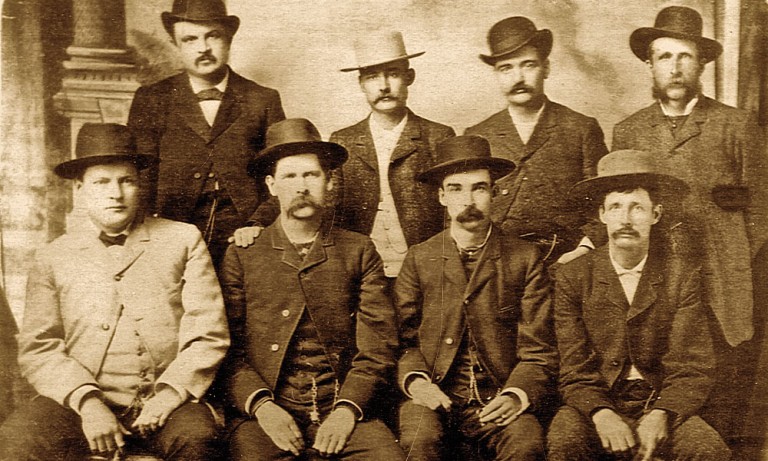
In 1883, Wyatt Earp was contacted by his friend Luke Short who told him of corruption in the town of Dodge City, Kansas. At this time, Dodge City had a reputation for criminal gangs and was often called “the Wickedest City in America.” In response to Short’s claims, Earp assembled a skilled army, including legendary figures Bat Masterson and Charlie Bassett. Dodge City Mayor Alonzo B. Webster negotiated peace with Wyatt Earp. He let Luke Short return to his place of business in return for a promise that there would be no violence. Earp and his friends moved to Dodge City and formed the Dodge City Peace Commission. In June of 1883, one of the most famous images from the Old West was taken. It shows Wyatt Earp and the Dodge City Peace Commission, including members, from left to right, standing: W.H. Harris, Luke Short, Bat Masterson, W.F. Petillon; and seated: Charlie Bassett, Wyatt Earp, Frank McLain and Neal Brown. This photograph has been scrutinized by many people, as three separate versions exist. In some copies, famed lawman Bill Tilghman appears, while in others W.F. Petillon is missing entirely.
7. Looking Down Sacramento Street

The San Francisco earthquake of 1906 was a major disaster that struck the city of San Francisco, California and the coast of Northern California. The quake ruptured along the San Andreas Fault northward and southwards for a total of 296 miles (477 km) and caused major damage in the western United States. The earthquake and resulting fire in San Francisco is remembered as one of the worst natural disasters in the history of the country, alongside the Galveston Hurricane of 1900. The Galveston Hurricane made landfall in the U.S. state of Texas, on September 8, 1900. The hurricane produced winds of 135 miles per hour (217 km/h) and devastated the city of Galveston, causing between 8,000-12,000 deaths. In comparison, the resulting death toll from the 1906 San Francisco earthquake was estimated to be around 3,000 people.
At the time of the quake, only 375 deaths were reported. The figure was fabricated by government officials who felt that publishing the true death toll would hurt real estate prices and efforts to rebuild the city. The disaster left between 227,000 and 300,000 people homeless, out of a population of about 410,000. The San Francisco earthquake and fire left a long-standing and significant impression on the development of California. The city of San Francisco was rebuilt quickly, but the disaster would divert trade, industry and population growth to Los Angeles. This mass migration is still evident today, with Los Angeles growing into the most important and populated urban area in the western United States. The overall cost of the damage from the earthquake was estimated to be around US$400 million, which is $9.5 billion in 2010 dollars.
The Photograph
The 1906 San Francisco earthquake was the first natural disaster of its magnitude to be documented by photography. On the morning of the earthquake, dozens of professional photographers covered the burning city. Among the crowd was famed photographer Arnold Genthe, who captured over 180 surviving pictures of San Francisco as it burned. Genthe used only a hand held camera. His most famous image is titled Looking Down Sacramento Street and shows a view from Nob Hill. In the distance, enormous clouds of smoke ominously approach, buildings’ facades have collapsed from the quake, and residents stand and sit in the street, calmly watching the approaching fire. The photograph shows “the results of the earthquake, the beginning of the fire, and the attitude of the people.” Many famous images were captured on the morning of the 1906 San Francisco earthquake, but Genthe’s picture has been praised for showing the attitude of the people at a time when they were faced with a true natural disaster. After the fire destroyed San Francisco, many famous photographers captured chilling panoramic views of the damage.
6. Young Miner

The Gilded Age was a term that Mark Twain used to describe the U.S. period of the late 19th century when there was a dramatic expansion of American wealth and prosperity. By the early 1900s, the United States rose as an industrialized power. These changes in lifestyle ultimately led to the Progressive movement, which pushed for reform in industry and politics. During this time, an unprecedented wave of immigration served both to provide the labor for American industry and create diverse communities in previously undeveloped areas. From 1880 to 1914, the peak years of immigration, more than 22 million people migrated to the United States.
In 1908, the Ford Motor Company helped change the world when they established an assembly line system to manufacture car parts. Unfortunately, during the early American industrial revolution, many employees were exposed to abusive work practices. This treatment directly led to the violent rise of the labor movement in the United States. Life for women and children during the industrial revolution was much different from modern times. The U.S. did not have any legislation regulating working conditions in mills, factories, and other industrial plants. As business operations quickly expanded, owners needed a large amount of cheap labor and they turned to women and children. Small kids were often given demanding jobs, working in dire conditions and with dangerous machinery.
The Photograph
Lewis Hine was an American photographer that used his camera as a tool for social reform. Many of Hine’s pictures were instrumental in changing the early child labor laws in the United States. At a young age, Lewis Hine became a teacher in New York City at the Ethical Culture School, where he encouraged his students to use photography as an educational medium. Many of Lewis Hine’s most famous images portray little girls in large factories or boys working as miners. In 1908, Hine captured a picture of a small child who had been working a long day mining underground. In the famous image, the young boy attempts to smile for the camera, but his physical pain is all that can be seen. The image does a great job visually describing what it was like for many children during the American Industrial Revolution. Many powerful photographs of child labor were captured during this time in United States history.
5. Migrant Mother
After the outbreak of World War I, the United States pursued a policy of non-intervention, avoiding conflict while trying to broker peace. When a German U-boat sank the British liner Lusitania in 1915, with 128 Americans aboard, U.S. President Woodrow Wilson vowed, “America is too proud to fight” and demanded that Germany end the attacks on passenger ships. In January of 1917, Britain’s secret Royal Navy cryptanalytic group, Room 40, intercepted a German coded message to Mexico, which suggested that Mexico should declare war on the United States with the help of Germany. U.S. President Woodrow Wilson released the information to the public to gain support for the war. He realized that a U.S. conflict was imminent, after German submarines sank numerous U.S. merchant ships.
The United States officially entered World War I on April 6, 1917. After the end of the war, the U.S. moved into the Golden Age of media, with the establishment of public radio and the first major broadcast networks. However, by the end of the 1920s, the U.S entered the Great Depression, which was the longest, most widespread, and deepest depression of the 20th century. The Great Depression originated in the United States, starting with the plummet of the stock market. The depression had devastating effects in virtually every country. Personal income, tax revenue, profits and prices dropped, while international trade plunged and unemployment in the U.S. rose to 25%. Tensions quickly elevated in major settlements around the United States and this era in U.S. history is full of dark and depressing pictures.
The Photograph
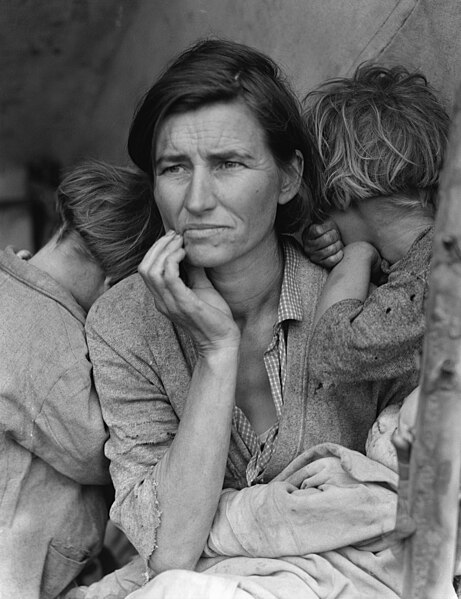
Dorothea Lange was an influential American documentary photographer, best known for her Depression-era work. Lange’s photographs humanized the tragic consequences of the Great Depression and profoundly influenced the development of documentary photography. Her best known images were taken in 1936, when she captured a set of pictures that would become known as the Migrant Mother collection. In March 1936, after picking beets in the Imperial Valley, Florence Owens Thompson and her family suffered car trouble near the city of Nipomo, California. Florence Thompson’s husband and sons took the car’s radiator to be fixed and she set up a temporary camp with her small children.
While the family waited for the men to return, Dorothea Lange approached Florence and took a collection of famous images. One of the pictures shows a close-up portrait of Florence Owens Thompson and her children. The image was published in newspapers all over the United States and has since reached near mythical status, symbolizing, if not defining, this entire era in U.S. history. It was not until the late 1970s that Thompson’s identity was discovered. She was quoted as saying “I wish she hadn’t taken my picture. I can’t get a penny out of it. She didn’t ask my name. She said she wouldn’t sell the pictures. She said she’d send me a copy. She never did.” As one of the most powerful photographs of the Depression era, Migrant Mother reflects the victims who suffered the most in the United States during the 1930s.
4. American Soldiers Storm Normandy

In 1939, Nazi Germany and the Soviet Union invaded Poland marking the beginning of the Second World War. In 1940, the Selective Service Act was passed in the United States. The law required that all men between the ages of 21 and 35 register with the U.S. draft board. On the morning of December 7, 1941, the Imperial Japanese Navy conducted a surprise attack on the United States at Pearl Harbor. The next day, the U.S. declared war on Japan resulting in the entry into World War II. Over the next four years of war, 418,000 U.S. soldiers were killed in battle. On January 16, 1945, the Red Army breached the German front and entered the city of Berlin. May 8, 1945, is officially Victory in Europe Day, when the Allies formally accepted the unconditional surrender of Nazi Germany. August 14, 1945, is Victory over Japan Day in the United States.
After the end of the Second World War, the Korean Peninsula, which was ruled by Japan since 1910, was divided along the 38th Parallel, with U.S. troops occupying the southern portion and Soviet troops occupying the north. In 1948, government officials failed to hold free elections on the Korean Peninsula and this deepened the division between the two sides. The North established a Communist government and the 38th Parallel became a political border between the two Koreas. On June 25, 1950, the conflict escalated into open warfare when North Korean forces invaded South Korea. This event marked the beginning of the Korean War (1950-1953). The U.S. came to the aid of South Korea, while China and Russia joined the communist north. The conflict ended after the threat of nuclear war was made and the Korean Demilitarized Zone (DMZ) was formed, which is a 2.5 mile (4.0 km) wide buffer zone between the two Koreas. Today, the DMZ is the most heavily militarized border in the world.
The Photograph
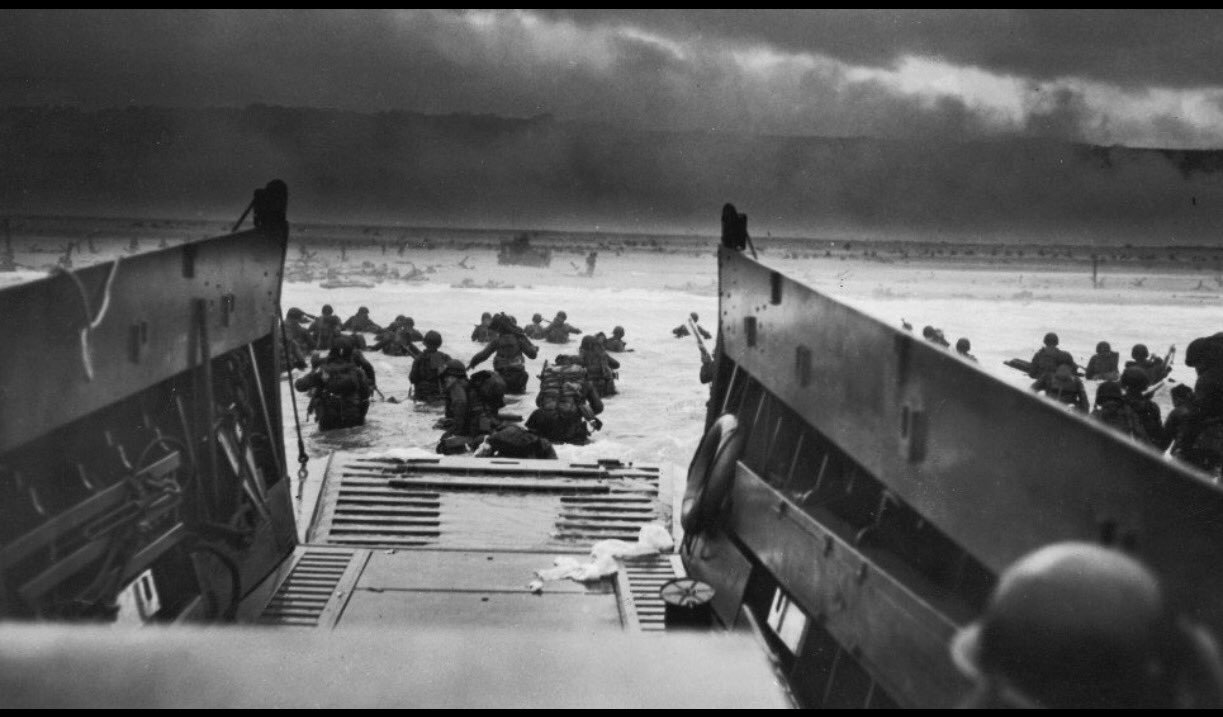
A number of famous American photographs were taken during the Second World War. The three most referenced images include the Conference of the Big Three at Yalta, which shows Prime Minister Winston S. Churchill, President Franklin D. Roosevelt, and Premier Josef Stalin in February of 1945. The Flag Raising on Iwo Jima is probably the most well known American photo in existence, while the picture taken of a happy couple celebrating the end of the war with a kiss in New York City is iconic. For this article, I have selected a war photo that was captured on June 6, 1944 (D-Day), as American soldiers swarmed the beaches of Normandy.
The Normandy landing was the largest amphibious invasion of all time, with over 160,000 Allied troops entering France on June 6, 1944. This famous image shows American soldiers as they leave the ramp of a Coast Guard landing boat and enter the frigid waters off Normandy. At the time that the picture was taken, these men were under heavy Nazi machine gun fire. They were forced to travel through the heavy tides and deep water holes, searching for solid land. Looking at this image, you can feel the wetness in the air and smell the gunpowder that looms over the battlefield. This photograph was taken under the intense pressures of war and gives a historic glimpse into the conflict.
3. Martin Luther King Jr. Assassination
In 1954, the U.S. Supreme Court Justice Earl Warren made a historic ruling. He granted the children of Oliver Brown the right to attend an all white school, striking down the “separate but equal” concept that was prevalent in the United States. Warren ruled that segregation violated the 14th Amendment of the U.S. Constitution. The decision led to the African-American Civil Rights Movement. During this time, acts of nonviolent protest and civil disobedience produced crisis situations between activists and police. The Civil Rights Act of 1964 granted equal access to public accommodations for everyone regardless of race, religion or national origin. The enactment of the law resulted from numerous demonstrations designed to show the hardships of segregation in America.
The United States also experienced a youth movement during the early 1960s, known as the hippy subculture. These people practiced the principle of free love, harmony with nature, communal living, world peace, artistic expression, and in many cases widespread experimentation with mind-altering substances. During this time, music grew in America like never before and Beatle Mania expanded. Bob Dylan emerged as a lyricist. Many of the pubic demonstrations included speeches in strong opposition to the U.S. involvement in the Vietnam War. The Vietnam War was a conflict that lasted from 1955-1975. The war was fought between North Vietnam, supported by its communist allies, and the government of South Vietnam, supported by the U.S. and other anti-communist nations. The conflict ended with the fall of Saigon on April 30, 1975, and the establishment of the Socialist Republic of Vietnam.
The Photograph
Serious Steps is an award-winning image that was captured in 1962. It shows President John F. Kennedy and former Commander-in-chief Dwight D. Eisenhower walking together. Two notable pictures that document the Vietnam War are titled Tank Commander and Dreams of Better Times, each of these images was awarded the Pulitzer or World Press honor. On May 4, 1970, four students were killed by the Ohio National Guard in the Kent State shooting. A photograph showing the lifeless body of 20-year-old Jeffrey Miller won the 1970 Pulitzer Prize. Martin Luther King Jr. was the most famous leader of the American civil rights movement.
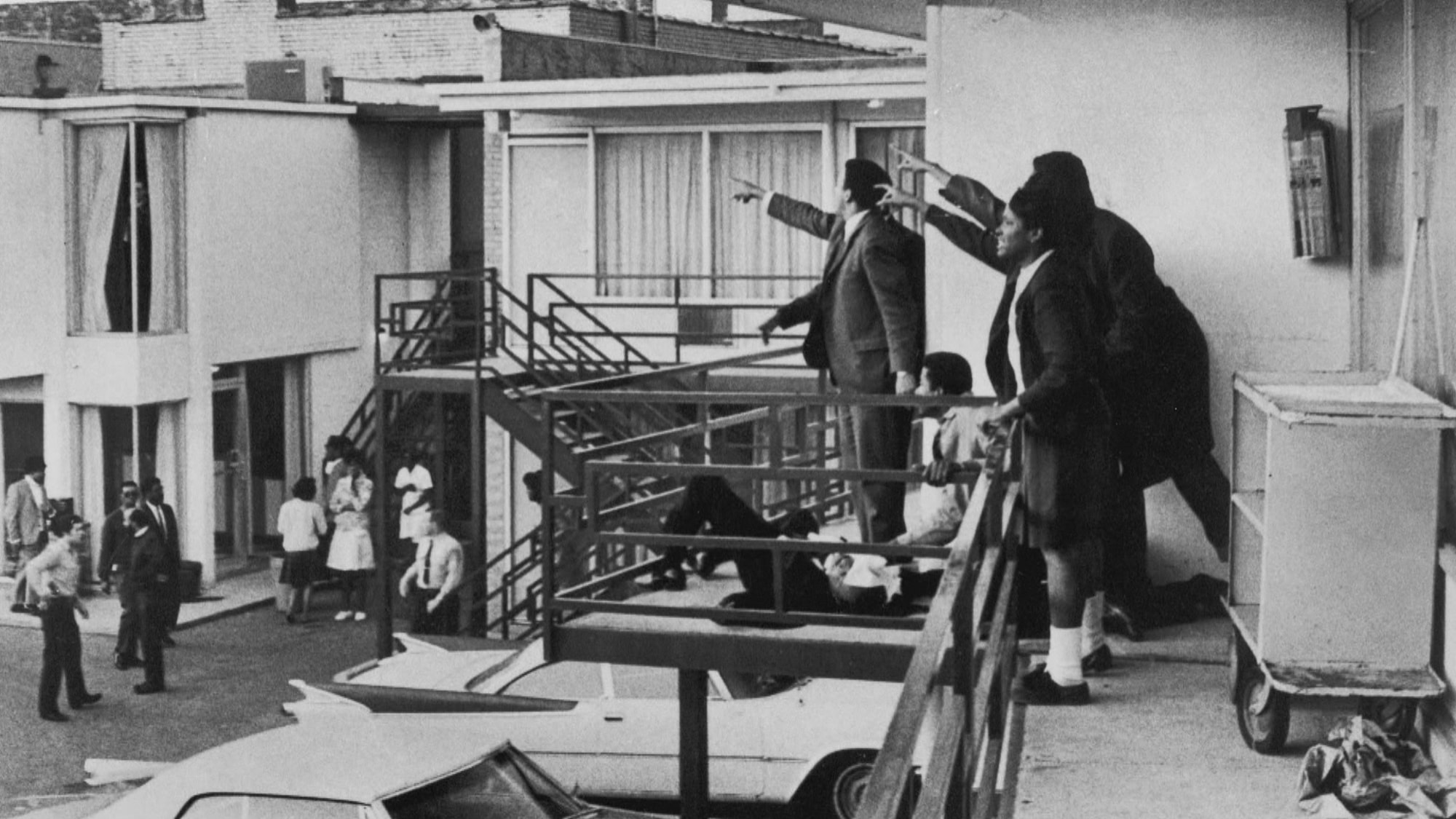
In 1964, King became the youngest man to be awarded the Nobel Peace Prize. On April 4, 1968, Martin Luther King Jr. was staying in room 306 at the Lorraine Motel, which is located in Memphis, Tennessee. While standing on the balcony of the hotel, King was fatally shot and wounded from a single gunshot to the head. After the shooting, Martin’s friends quickly rushed to his side and desperately tried to stop the bleeding. They were also pointing in the direction of an old run down hotel across the street. The moment was captured by photographer James Louw. The image has since become one of the most famous in U.S. history. It shows the fatally wounded Martin Luther King Jr. laying at the feet of his friends, while they yell for help. It is a descriptive photograph that shows what the scene was like when King was assassinated. You can see his leg propelled up against the balcony bars, with large pools of blood forming. In 1986, Martin Luther King Day was established as a United States holiday, only the fourth Federal holiday to honor an individual, with the other three being in honor of Jesus of Nazareth, George Washington, and Christopher Columbus.
2. America Walks on the Moon

The Photograph
A number of famous photographs were taken during the Apollo 11 space mission. The pictures of the American flag on the moon and of the first human footprint are lasting. I was going to include the photograph of the first step on the moon, but Armstrong’s leap was not documented. There is a famous picture of Buzz Aldrin jumping from the Command Module to the moon. The photograph that I have selected was taken from the Apollo 15 mission, which was the fourth flight to land on the moon. The picture gives a panorama view of the crew’s space vehicles and the American flag. In the picture, Lunar Module Pilot James Irwin can be seen giving a salute to the people of the world. It is a revealing photograph and shows the technical equipment used to travel to the moon and back. If you look closely, the moon’s surface can be viewed with human footprints scattered around. This image represents an incredible achievement in the history of the United States.
1. September 11, 2001
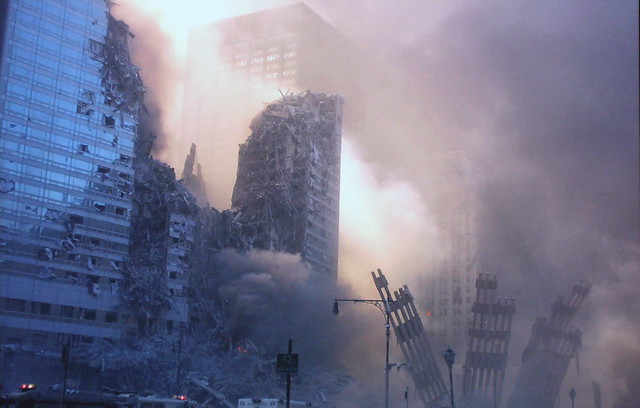
In 1975, Bill Gates founded Microsoft and the U.S. was launched into the age of technological advancement. In 1977, the first home personal computer, Commodore PET, was released for retail sale. By the 1990s, the Internet was beginning to take hold. The basic applications and guidelines that make the Internet possible have existed since the 1960s, but the network did not gain a public face until the 1990s. The estimated population of Internet users is 1.97 billion as of July 2010.
On August 2, 1990, the Gulf War began in the Middle East. The conflict was waged by a U.N. authorized coalition force from thirty-four nations, led by the U.S. and United Kingdom, against Iraq. On September 11, 2001, the United States faced the biggest terrorist attack in history when 19 individuals hijacked four U.S. planes and crashed them into the World Trade Centers, the Pentagon, and a field in Shanksville, Pennsylvania killing nearly 3,000 people and injuring over 6,000.

On September 11, all civilian air traffic was suspended for three days. It was the first time that an unplanned air flight suspension had occurred in the United States. In response to the terrorist attacks, the U.S. and U.K. declared war on Afghanistan and invaded the country on October 7, 2001. The United States government reported that the reason for invading Afghanistan was to find Osama bin Laden and to destroy the organization of Al-Qaeda. As of 2011, the United States is still at war in Afghanistan with no current leads regarding the location of Osama bin Laden. On March 20, 2003, the United States and United Kingdom invaded and occupied the country of Iraq, starting the Iraq War. Recently, top U.S. military commanders in Iraq have said they believe all U.S. troops will be out of the country by the end of 2011. The two separate wars have become a controversial subject in the United States, especially since the economic status of the nation has greatly declined since 2008.
The Photograph
The most famous image to emerge from the September 11 attacks is titled Ground Zero Spirit and shows firefighters raising the American flag against a tangle of iron and debris at Ground Zero in New York City. For this article I have selected a picture that was taken by Bill Biggart. Bill Biggart was the only working photojournalist to die on 9/11. After the World Trade Centers were attacked, Bill Biggart traveled to the buildings to document the event. He had three separate cameras, one being digital. As the South Tower collapsed, Biggart snapped a famous collection of four photographs. He was killed when the North Tower came down. However, his camera bag was miraculously discovered in the wreckage. Most of his pictures were unsalvageable, but the flash card in the digital camera was saved and some photographs were retrieved. This image shows one of Biggart’s pictures as the South Tower collapsed to the ground. You can see the burning North Tower still standing, a building that would later fall, killing Biggart. In the picture, look at the destruction and large pieces of debris traveling with the slide. Bill Biggart will always be remembered for his bravery.
One More
The Dust Bowl

A contributing factor to the Great Depression in America was the Dust Bowl or Dirty Thirties. The Dust Bowl was a period of severe dust storms that caused major ecological and agricultural damage to American and Canadian prairie lands. The phenomenon was caused by a severe drought coupled with decades of farming without crop rotation or other techniques to prevent erosion. Without the natural anchors in the dirt, the soil dried, turned to dust, and blew away in large dark clouds. At times the clouds blackened the sky all the way to the East Coast of America and damaged cities such as New York and Washington, D.C. The immense dust storms, given the name Black Blizzards, often reduced visibility to a few feet (around a meter).
Millions of acres of farmland became useless, and hundreds of thousands of people were forced to leave their homes. The people who stayed had their land taken over by dust and sand, often times leading to unsanitary conditions, respiratory illness, and even sudden death in children. On April 14, 1935, known as Black Sunday, the most destructive Black Blizzard struck the Great Plains, causing extensive damage and turning day to night. Sadly, during this era, many American families lost their land and were forced to travel west taking various jobs at starvation wages. The Dust Bowl exodus was the largest migration in American history within a short period of time. By 1940, 2.5 million people had moved out of the Plains states.
The Photograph
The United States government responded to the Dust Bowl crisis and President Roosevelt ordered the Civilian Conservation Corps to plant a huge belt of more than 200 million trees from Canada to Abilene, Texas to break the wind, hold water in the soil, and to keep the dirt in place. The administration also began to educate farmers on soil conservation and anti-erosion techniques, including crop rotation, strip farming, contour plowing, terracing, and other improved farming practices. Many famous images of the Black Blizzards have survived from this time in American history. This photo shows a dust storm looming on the horizon of a small farming community, with a collection of people awaiting the blizzards arrival.
29 Comments
I spent a week at Gettysburg and can tell you for sure that the Devil’s Den battlefield is the most disquieting place I have ever been. Before I even knew what happened there I was overwhelmed by a sense of hopelessness and that was just while taking a bus tour.
My wife and I went back the next day on our own and I got completely creeped out. Climbing around the rocks was bad enough but I could live with it, but when I tried to cross the creek into the meadow I couldn’t bring myself to do it. It felt like I would be walking into certain death, and the sadness was so heavy it brought tears to my eyes. Meanwhile, people are picnicking like they are at Disneyland and their monster kids are treating that sacred ground like a jungle gym.
There are a couple other intense places on the battlefield, but nothing like that. Not even close.
So so good! Great post…
Thank you for the pix and the detailed note.
Nice Job!
Kents State? Earth rise from Apollo 8? Firefighters and police officers carrying Fr. Michael Judge from the ruins on 9/11?
Um? why isnt the flag raising in iwo jima not up there?
The author explained this in response to comments above. He decided to focus on less known pictures. As the site editor, I probably should have titled it differently.
Great post. I’m searching for photos (specifically of American flags) to use as history trivia questions for my students. I found this post that highlights a few of the same events you did:
http://www.allstarflags.com/facts/Top-10-American-Flag-Moments-in-History/
You might find it useful for a future post!
That is some interesting stuff. Nice suggestion.
What about The Falling Man at the WTC?
http://2.bp.blogspot.com/_t6ikLJ4YVos/RcJOC2vmn2I/AAAAAAAAABk/EXIab69MKAc/s320/Nguyen.jpg
and
http://www.channel4.com/assets/programmes/images/911-the-falling-man/911-the-falling-man-20090515123420_625x352.jpg
both have directly affected the country in some way
Neat list, here’s a few I felt should’ve at least been mentioned: some affected us directly, others came back to haunt us
The infamous Colonel Loan and a Viet Cong Prisoner photo:
http://www.cs.brown.edu/courses/cs024/images/canon/06.jpg
The Afghani Girl:
http://en.wikipedia.org/wiki/File:Sharbat_Gula.jpg
Couple embracing on V-J Day:
http://www.mentalfloss.com/blogs/wp-content/uploads/2009/11/VJ-Day.jpg
Separate Drinking Fountains:
http://whereintheworldispatty.com/wp-content/uploads/2010/02/black-and-colored-drinking-water1.jpg
Aftermath of Gettysburg (first widely distributed U.S. war photos):
http://freepages.history.rootsweb.ancestry.com/~historyofmarlborough/gettysburg.jpg
Mushroom Cloud over Hiroshima:
http://www.laprogressive.com/wp-content/uploads/2009/08/HiroshimaAtomicBomb_02.gif
The Falling Man(9/11):
http://www.channel4.com/assets/programmes/images/911-the-falling-man/911-the-falling-man-20090515123420_625x352.jpg
The first permanent photograph was indeed created by Joseph Nicephore Niepce in about 1826, but it was called “View from the Window at Le Gras” and was just a bunch of roofs outside his window. “Boulevard du Temple” is generally considered the first photograph of a person, and was made by Louis Daguerre in about 1838.
The Dorothea Lange picture was staged. She asked the children to look away. Many of the pictures taken during that time were staged. A shame for the people so badly affected by the Depression.
The Little Round Top to Devil’s Den doesn’t show a Union soldier looking down at Devil’s Den, as explained in the entry. That’s a statue of General Gouverneur K. Warren, which is still there. The photograph even shows the little sign that’s still there telling people not to climb up on the rock.
Thanks, Bryan. The author as edited the article to reflect this change.
I enjoyed reading this, I’m British, alot of people over here are abit snobby about America but I think it’s a brilliant place and American history is fascinating, you should all be proud to be American. The 9/11 photos still give me goosebumps and make me feel sick, it’s so tragic, RIP to all those poor people who lost their lives on that horrific day!
It could be 10 Pictures that Helped Shape America, instead of “Top Ten,” but long titles aren’t usually user or Google freindly.
Don’t Be a Menace to South Central While Drinking Your Juice in the Hood
Taumatawhakatangihangakoauauotamateapokaiwhenuakitanatahu
I agree Brian, I’m changing the title.
‘One thing this article is not is hastly done. In selecting the photographs, I wanted to use pictures that might be unknown to some Americans. Everyone has seen the Iwo Jima photo hundreds of times, but the other live action shot of D-Day is less known, but as influential in the long run. I mentioned the other photographs throughout the text because I understood that people would want them recognized. For those people who say that these pictures didn’t shape America, I disagree. If I wanted to I could make an article showing the most recognizable images in American history.’
ok, then you should have titled this article ’10 Pictures that you may not have seen, that shaped America’ The live action shot of D-Day has nothing on the Raising of the flag at Iwo Jima.
Hey, opinions will differ. Good on you for taking a thoughtful stab at it!
From Entry 4
“The three most referenced images include the Conference of the Big Three at Yalta, which shows Prime Minister Winston S. Churchill, President Franklin D. Roosevelt, and Premier Josef Stalin in February of 1945. The Flag Raising on Iwo Jima is probably the most well known American photo in existence, while the picture taken of a happy couple celebrating the end of the war with a kiss in New York City is iconic. For this article, I have selected a war photo that was captured on June 6, 1944 (D-Day), as American soldiers swarmed the beaches of Normandy.”
One thing this article is not is hastly done. In selecting the photographs, I wanted to use pictures that might be unknown to some Americans. Everyone has seen the Iwo Jima photo hundreds of times, but the other live action shot of D-Day is less known, but as influential in the long run. I mentioned the other photographs throughout the text because I understood that people would want them recognized. For those people who say that these pictures didn’t shape America, I disagree. If I wanted to I could make an article showing the most recognizable images in American history.
Wheres the raising of the flag at Iwo Jima?
This was obviously hastily done, this wasnt about photos that shaped America so much as events. The photos shown of some events arent the iconic ones recognized by Americans. Also, how the flag raising on Iwo Jima is not in the top three I dont know, seeing as how it immediately became the icon for American victory everywhere.
I was thinking the Iwo Jima as well. Also none from the Oklahoma bombing. The one with the fire fighter carrying the baby out of the rubble.
hey wat about wen they raised the flag on iwo jima??
I, too, am surprised there aren’t any Vietnam War photos. Either Eddie Adams’s “General Nguyen Ngoc Loan Executing a Viet Cong Prisoner in Saigon” or, as mentioned previously, Nick Ut’s photo of Phan Thá»? Kim Phúc running from the napalm attack on Trang Bang.
Great list. There are so many photographs that could be on here. I’d have given myself an anuerism if I tried to do this list.
That’s not Niel Armstrong. It’s Apollo 15 Lunar Module Pilot James Irwin.
http://en.wikipedia.org/wiki/Apollo_15
You forgot the picture of the naked little girl running down the streets during the Vietnam War. That picture should be in the top ten somewhere. Other than that, good job!!
This list should be titled “Photos of situations that shaped america”. None of these photos (possibly No.6) shaped the USA, it’s the situation that is captured that changed your country.